Collateral management is the process of tracking, valuing, monitoring, and managing assets pledged to secure a loan. It helps banks, credit unions, and commercial lenders ensure collateral remains properly documented, adequately valued, and sufficient to support the outstanding balance. Collateral may include real estate, equipment, inventory, accounts receivable, vehicles, and securities. For example, a $1 million loan secured by $1.5 million in assets requires ongoing monitoring. Modern collateral management software can automate 20+ tasks, including valuations, lien tracking, insurance monitoring, and exception alerts.
A regional commercial lender discovered the problem during a CRE workout on a mixed-use property that had gone into a nonperforming status. The UCC-1 financing statement filed against the borrower’s equipment at origination had lapsed eighteen months earlier. Nobody had scheduled the five-year continuation filing. A junior creditor who had filed a UCC-3 continuation on a competing security interest had maintained their perfection. The senior lender’s priority position, which the loan file clearly showed as secured, was no longer legally enforceable. The recovery analysis shifted materially in the space of one conversation with outside counsel.
Nobody had done anything wrong at origination. The lien was filed correctly, the documentation was complete, and the credit had been underwritten with care. The problem was that collateral management had been treated as a documentation task rather than a continuous monitoring discipline. The five-year statutory clock had run out while the institution was watching something else.
Key Takeaways About Collateral Management
Collateral management is a core part of lending strategy, influencing credit risk, liquidity, capital efficiency, and the overall strength of a lender’s balance sheet.
Collateral is becoming more complex to manage as lenders handle a wider range of asset types, changing valuations, evolving regulatory requirements, and increasingly digital lending processes.
Real-time visibility is becoming essential. Lenders need accurate information about collateral value, ownership, insurance, documentation, eligibility, and exposure throughout the loan lifecycle.
Technology can make collateral management more efficient. Automation, centralized data, digital workflows, and system integrations can help lenders reduce manual work, identify exceptions earlier, and improve collateral mobility.
Effective collateral management goes beyond simply tracking assets. Lenders also need to consider collateral quality, liquidity, valuation, legal enforceability, concentration risk, and how efficiently an asset supports the institution’s lending objectives.
Strong controls and data accuracy remain critical. Even with automation, lenders need reliable processes for valuations, documentation, insurance, lien monitoring, inspections, and compliance.
The future of collateral management will be increasingly connected and data-driven, giving banks and credit unions better transparency, faster decision-making, and greater control over collateral across their commercial loan portfolios.
What Collateral Management?
Collateral management is the ongoing process of tracking, monitoring, valuing, and maintaining the legal enforceability of the assets that secure a commercial loan portfolio. Starting from the day a loan funds through its repayment or resolution. It is a different and more demanding function than collateral capture at origination, which is where most institutions concentrate their effort and attention.
Collateral is identified, appraised, and perfected at origination. Then the lien is filed, the flood certification is obtained, the title policy is issued, and the asset is documented in the loan file. That process is well understood and generally well executed. What happens afterward is where the discipline of collateral management begins and where most institutions’ systematic attention ends.
The lifecycle of collateral after funding has several distinct phases. Valuations need to be updated as market conditions shift, because the appraisal completed at origination reflects conditions that may no longer exist. Lien documentation must be maintained for currency: under Article 9 of the Uniform Commercial Code UCC-1 financing statements lapse after five years unless a continuation statement is filed within the six-month window before that anniversary. Flood certifications expire. Title issues that were noted and deferred at closing can become consequential during a workout. LTV ratios need to be recalculated as the loan amortizes and collateral values move, because the coverage that existed at funding may have drifted significantly in either direction. Across all of this, exceptions need to be tracked, resolved, and documented in a form that satisfies examiner scrutiny.
Effective collateral management solution helps lenders maintain accurate visibility into the assets securing their loans. By tracking collateral values, ownership, insurance, documentation, and required reviews, banks and credit unions can identify risks earlier, support compliance, and make more informed lending decisions. A centralized collateral management process also reduces manual work and helps lenders manage growing commercial loan portfolios more efficiently. Ultimately, strong collateral management helps protect the lender while creating a more organized and transparent lending process.
Treating this as an origination function that continues passively into the life of the loan is the fundamental misunderstanding that produces most collateral management failures.
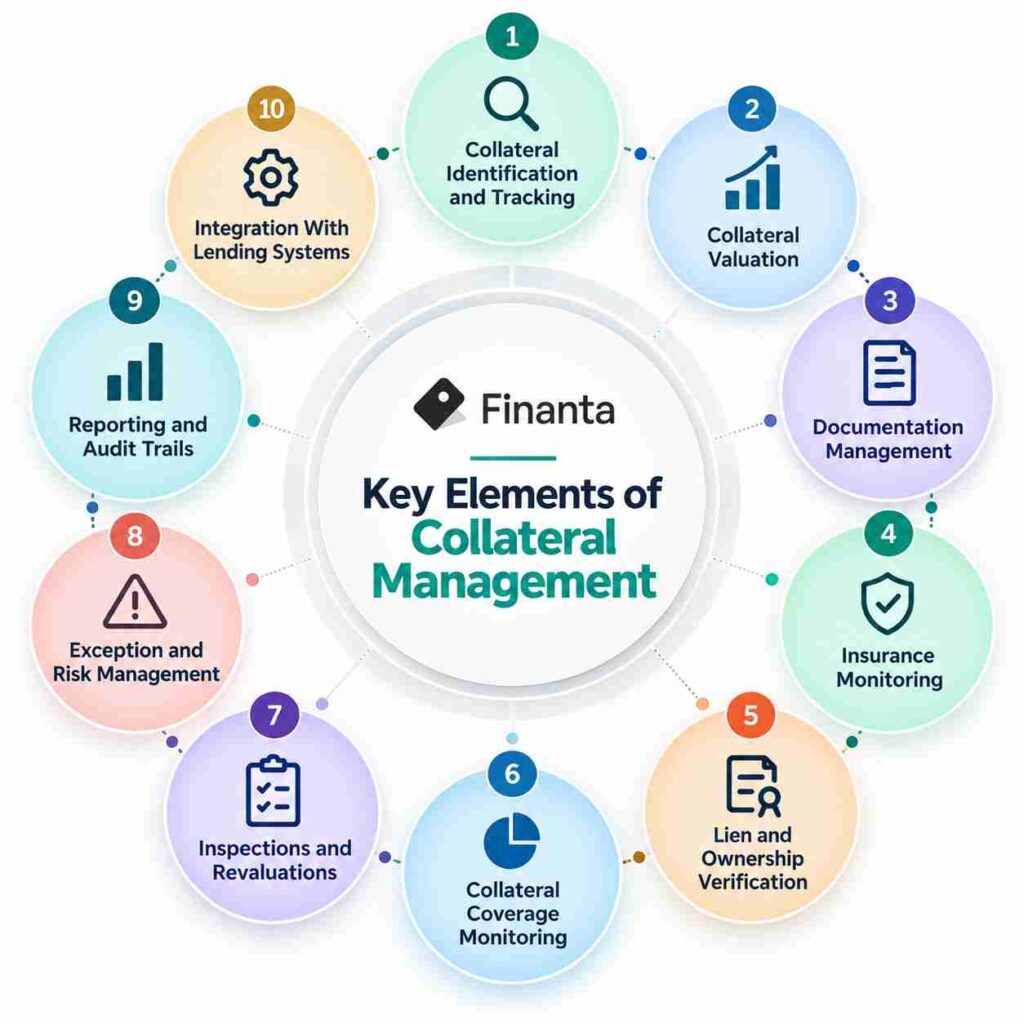
Key Elements of Collateral Management
The effective key elements of collateral management are identification, valuation, documentation, insurance, lien monitoring, coverage tracking, inspections, exception management, reporting, and system integration. Together, these processes help lenders manage collateral throughout the commercial loan lifecycle, reduce operational risk, and make better-informed commercial lending decisions.
Collateral Identification and Tracking: Lenders need to maintain accurate records of every asset securing a loan, including real estate, equipment, inventory, vehicles, securities, and accounts receivable. Each asset should be linked to the appropriate borrower and loan facility.
Collateral Valuation: Regular and accurate valuations help lenders determine whether collateral provides sufficient coverage for the outstanding loan. Depending on the asset type, valuations may involve appraisals, market values, inspections, or automated valuation methods.
Documentation Management: Important documents such as appraisals, title documents, insurance certificates, UCC filings, inspection reports, and legal agreements need to be stored and easily accessible. Complete documentation helps reduce operational and compliance risks.
Insurance Monitoring: Lenders often require borrowers to maintain appropriate insurance on pledged assets. Collateral management includes tracking policy coverage, expiration dates, renewals, and required documentation so potential gaps can be identified early.
Lien and Ownership Verification: Lenders need to confirm that they have the appropriate legal interest in the collateral. This can include monitoring liens, titles, ownership records, and UCC filings, depending on the asset and jurisdiction.
Collateral Coverage Monitoring: Collateral values can change over time. Monitoring loan-to-value (LTV) ratios and collateral coverage helps lenders identify situations where the value of pledged assets may no longer adequately support the outstanding exposure.
Inspections and Revaluations: Certain assets may require periodic physical inspections or updated valuations. This is particularly relevant for commercial real estate, equipment, inventory, and other assets whose condition or value can change.
Exception and Risk Management: A strong collateral management process should identify issues such as expired insurance, missing documents, outdated valuations, insufficient coverage, or overdue inspections. Automated alerts can help lending teams address these exceptions before they become larger problems.
Reporting and Audit Trails: Lenders need clear reporting on collateral across individual loans and the broader portfolio. A centralized system can provide an audit trail showing what collateral is pledged, its current value, required actions, and changes over time.
The Collateral Types Commercial Lenders Deal With, And Why the Diversity Is the Problem
The commercial lending collateral landscape is not uniform, and the management challenge it creates is not simply a matter of volume. It is a matter of diversity instead, and that diversity itself is the problem. Different collateral types behave differently across the life of a loan, depreciate on different curves, require different revaluation frequencies, and carry different lien perfection mechanisms. An institution applying a single generic monitoring process to all of them is applying logic that was designed for one asset class to assets that behave nothing like it.
Commercial real estate is the largest collateral category by value in most commercial portfolios. CRE values drift with market conditions, interest rate movements, occupancy trends, and local economic factors in ways that can diverge significantly from origination-era appraisals over a three to five year period. Office and non-owner-occupied properties in particular have seen material valuation shifts since 2022 as higher-for-longer rates and structural changes in office demand have compressed values and refinancing capacity simultaneously.
The OCC’s Comptroller’s Handbook on Commercial Real Estate Lending requires institutions to have adequate appraisal and evaluation programs that address when reappraisals are required, and examiners look specifically at whether appraisal programs are keeping pace with market conditions rather than defaulting to origination-era valuations.
Equipment collateral depreciates on asset-class-specific curves that frequently run faster than the loan amortizes. This is particularly true in technology-intensive industries where secondary market values can deteriorate sharply within eighteen to twenty-four months of purchase. A piece of manufacturing equipment that was worth 80 cents on the dollar at origination may be worth 40 cents two years later, while the loan balance has declined only slightly. The institution that is not tracking equipment values against current secondary market benchmarks is carrying LTV exposure that has not been measured.
Agricultural collateral introduces a different set of dynamics entirely. Commodity price cycles can move collateral values significantly within a single growing season. A farm operation secured by standing crop inventory or livestock has collateral that changes in value with commodity markets, weather events, and seasonal cash flow patterns in ways that no annual review cycle can adequately capture. The revaluation and monitoring requirements for agricultural collateral are fundamentally different from those for a stabilized office building or a piece of industrial equipment.
Inventory and accounts receivable present the most operationally intensive monitoring challenge. Unlike fixed assets, these collateral types fluctuate continuously with business performance. A revolving line of credit secured by receivables requires ongoing borrowing base certificate monitoring, periodic field audits to verify the quality and aging of the receivable pool, and continuous attention to the concentration of the receivable base. The lender who files the original security agreement and then monitors the facility annually is not managing this collateral. They are documenting it.
The institution that manages all of these through a common spreadsheet or a periodic review cycle is not making a minor process efficiency compromise. It is applying monitoring logic built for one asset class to a portfolio of assets that require fundamentally different approaches, and the gaps that causes accumulate quietly until a workout surfaces them.
Why Is Collateral Management Important?
Secure Collateral management system is important because it helps lenders protect their financial interests, manage lending risk, and maintain accurate information about the assets securing their loans. For banks, credit unions, and commercial lenders, collateral can include real estate, equipment, inventory, accounts receivable, vehicles, securities, and other business assets. Without a structured way to monitor these assets, lenders can face outdated valuations, missing documents, expired insurance, and unexpected exposure.
1. Reduces Lending Risk
Collateral provides lenders with an additional layer of protection if a borrower cannot repay a loan. Effective collateral management helps lenders know what assets are pledged, their current value, ownership details, and whether the collateral continues to provide adequate coverage.
By regularly monitoring collateral, lenders can identify potential risks early rather than discovering problems when a loan is already distressed.
2. Keeps Collateral Information Accurate
Collateral information can change throughout the life of a loan. Property values may increase or decline, equipment can depreciate, insurance policies can expire, and ownership or lien information may change.
A centralized collateral management process helps lenders maintain up-to-date records and reduces the risk of relying on outdated information when making lending decisions.
3. Supports Better Loan Decisions
Lenders need accurate collateral information when underwriting new loans, renewing existing facilities, increasing credit limits, or reviewing a borrower’s overall exposure.
When collateral data is readily available, credit teams can assess loan-to-value ratios, collateral coverage, exposure, and risk more efficiently. This can support faster and more informed credit decisions.
4. Helps Maintain Compliance
Collateral management also plays an important role in regulatory and internal compliance. Lenders may need to maintain documentation related to appraisals, insurance, liens, ownership, inspections, and other collateral requirements.
A structured process creates a clearer audit trail and makes it easier for lenders to demonstrate that required collateral controls are being followed.
5. Prevents Missed Renewals and Expirations
Managing collateral involves more than knowing what asset secures a loan. Lenders may also need to monitor insurance expiration dates, appraisal dates, inspection schedules, UCC filings, environmental reports, and other important documents. Automated alerts and centralized records can help teams identify upcoming deadlines before they become exceptions or create unnecessary risk.
6. Improves Operational Efficiency
Many lenders still spend significant time searching through spreadsheets, emails, shared folders, and different systems to find collateral information. This creates repetitive work and increases the possibility of errors. Collateral management software can bring this information into one place, allowing lending and operations teams to spend less time on manual tracking and more time on higher-value work.
7. Provides Better Portfolio Visibility
Collateral management becomes especially important as a commercial loan portfolio grows. Instead of reviewing individual files manually, lenders can get a broader view of collateral across their portfolio.
This can help teams identify:
Assets with outdated valuations
Loans with insufficient collateral coverage
Expiring insurance policies
Missing or incomplete documentation
Changes in collateral value
Concentration and exposure risks
Upcoming appraisal or inspection requirements
8. Strengthens the Borrower and Lender Relationship
Efficient collateral management can also improve the lending experience. When lenders have accurate information readily available, they can respond to borrower requests more quickly and reduce unnecessary document requests.
For commercial borrowers, this can mean smoother renewals, reviews, amendments, and credit processes.
Why the Stakes Around Collateral Management Are Higher Right Now
Several forces have converged to raise the cost of collateral management gaps beyond where they sat five years ago, and the combination is worth understanding clearly.
CRE collateral values have shifted materially since the origination appraisals were completed on loans written between 2020 and 2023. As established in the context of the broader loan portfolio management pressure facing commercial lenders, office and non-owner-occupied CRE portfolios are carrying noncurrent rates at levels not seen since 2013 per FDIC Q4 2024 data. For any institution holding loans in those segments with origination-era appraisals that have not been updated, the collateral coverage assumed in the credit file and the collateral coverage that would be realized in a default and liquidation scenario may be materially different numbers.
The regulatory expectation around this is explicit. The 2023 Interagency Policy Statement on Prudent Commercial Real Estate Loan Accommodations and Workouts, issued jointly by the OCC, Federal Reserve, FDIC, and NCUA through SR Letter 23-5, requires institutions to have written policies and procedures that dictate when collateral valuations must be updated as part of ongoing credit risk reviews, as market conditions change, or as a borrower’s financial condition deteriorates. This is not aspirational guidance. Examiners review these policies, assess whether they are being followed, and adjust their view of an institution’s credit risk management accordingly. An institution that cannot demonstrate a systematic approach to collateral revaluation is an institution that is not meeting baseline regulatory expectations on this point.
The volume problem compounds both of the issues above. As noted in the portfolio management context, total bank credit has crossed $19.3 trillion. Institutions that built their collateral monitoring processes for books of two hundred loans now could find themselves managing books of four or five hundred loans with the same processes, the same staffing, and the same manual tracking infrastructure. The revaluation schedules, lien renewal deadlines, exception management workflows, and flood certification tracking that were manageable at smaller scale are not scaling at the same rate as the portfolios they were designed to oversee.
What Is a Collateral Loan?
A collateral loan is a type of secured loan where a borrower pledges an asset to a lender as security for the borrowed money. This approach, often associated with collateral finance, gives the lender additional protection if the borrower fails to repay the loan according to the agreed terms.
Collateral can include real estate, vehicles, equipment, inventory, accounts receivable, securities, or other valuable business assets. For example, a business may use commercial property or equipment as collateral to secure financing.
Before approving a collateral loan, the lender typically evaluates the asset’s value, ownership, condition, and legal status to determine whether it provides sufficient security for the requested loan amount. The lender may also monitor the collateral throughout the loan lifecycle. If the borrower defaults, the lender may have the legal right to take possession of and sell the pledged asset, subject to the loan agreement and applicable laws, to recover some or all of the outstanding debt.
In collateral finance, effective collateral management is important for keeping track of pledged assets, valuations, insurance, documentation, and other requirements. This helps lenders manage risk, maintain accurate records, and make informed lending decisions throughout the life of a loan.
Where Most Lenders Fall Short
The root failure is consistent across institution types and sizes: collateral management is treated as a documentation discipline rather than a monitoring discipline. The collateral file is assembled carefully at origination, filed correctly, and then left to the periodic review cycle to catch whatever changes have accumulated. That approach was adequate when books were smaller, when market conditions were more stable, and when the regulatory bar for collateral management documentation was lower. None of those conditions holds true today.
The first downstream manifestation is stale valuations. Appraisals completed at origination that have not been updated since closing leave the institution carrying loans against collateral values that may no longer reflect current market reality. This is particularly acute in CRE portfolios where market conditions have shifted materially, but it applies across asset classes: equipment that has depreciated faster than the amortisation schedule, inventory that has declined in value with a borrower’s business performance, agricultural land that has moved with commodity market cycles. The institution that discovers a stale valuation problem during a workout has lost the ability to address it proactively. The institution that identifies it through continuous monitoring retains options.
The second manifestation is lien perfection gaps. Under Article 9 of the Uniform Commercial Code, a UCC-1 financing statement lapses after five years unless a UCC-3 continuation statement is filed within the six-month window before the fifth anniversary of the original filing date. This is a statutory requirement with no grace period: a lapse in perfection means the security interest is no longer enforceable against other creditors, and a junior creditor who has maintained their filings will have priority over a senior lender who has not.
Flood certifications carry their own expiration requirements. Title issues that were noted at origination and deferred can crystallize during a workout into coverage gaps that could have been resolved at far lower cost earlier in the loan’s life. Exception tracking and tickler management for these deadlines is not a compliance formality. It is the mechanism that keeps a secured loan actually secured.
The third manifestation is LTV drift. The loan-to-value ratio calculated at origination is a point-in-time measurement. As the loan amortizes, the numerator changes. As collateral values move with market conditions, the denominator changes. An institution that does not recalculate LTV ratios continuously is carrying credit risk it cannot see or price, and it will discover how much that risk has grown either at the next scheduled review or, more expensively, at the point of default. Policy thresholds that trigger enhanced monitoring or collateral calls exist precisely to catch LTV drift before it reaches a level that constrains recovery options.
The fourth manifestation is exception accumulation. Individual collateral exceptions, a missing insurance certificate, an overdue financial statement, an expired flood certification, a collateral valuation that has not been updated on schedule, are manageable in isolation. The same exceptions accumulating across twenty or thirty loans simultaneously are a portfolio risk pattern that signals systemic gaps in the monitoring process. Institutions that track exceptions in separate spreadsheets or individual loan files, rather than aggregating and surfacing them as a portfolio-level signal, are missing the early warning function that exception management is supposed to serve.
What Collateral Management Looks Like When It’s Working
An institution with properly functioning collateral management infrastructure looks different in every facet that matters to a credit officer preparing for an exam or a board presentation. Every collateral record carries a current valuation that reflects market conditions rather than origination assumptions. Every UCC filing has a tracked continuation deadline with a workflow that triggers action well before the six-month filing window closes. Every flood certification has an expiration date in the system rather than a folder in a file cabinet. Every LTV calculation reflects the current loan balance against a current collateral value, so the question of whether a given loan is inside or outside policy coverage is answered by pulling a report rather than by building a spreadsheet.
This is the operational reality that Finanta’s collateral management platform is built to sustain. The Collateral 360 view maintains a complete collateral record for every loan in the book: collateral allocation, current LTV calculations, remaining equity position, and full documentation history in a single interface rather than distributed across filing systems and spreadsheets. The platform integrates directly with flood certification providers including (but not limited to) CoreLogic, Service Link, and National Flood Data, and with lien filing agencies including Wolter Kluwer, First Corporate, and CSC Global, which means the documentation currency tracking that most institutions currently perform manually through calendar reminders and spreadsheet flags is automated at the infrastructure level. Exception tracking and workflow routing surface collateral exceptions as they develop and route them to the appropriate team member with built-in escalation, so the exception that would have aged unnoticed in a spreadsheet becomes an action item with an owner and a deadline.
Conclusion
Collateral management in commercial lending is not a paperwork function with a monitoring component attached. It is a continuous risk discipline that determines the institution’s actual recovery position on every secured loan in the book. The gap between how most institutions manage it and what sound practice actually requires is not closing on its own, and in the current environment of CRE valuation stress, elevated noncurrent rates, and growing portfolio complexity, the cost of that gap is rising.
The origination process gets the collateral relationship right. What happens over the subsequent five or ten years of a loan’s life, across market cycles, rate movements, borrower condition changes, and regulatory expectation shifts, is where the discipline either holds or breaks down.
How to Avoid the Most Common Collateral Management Pitfalls
Most collateral management failures are not caused by poor underwriting. They are caused by processes that were built for a smaller, simpler book and never updated as the portfolio grew. Four disciplines prevent the majority of the failures described in this piece.
The first is treating lien currency as a live obligation rather than an origination task. UCC-1 continuation deadlines, flood certification expirations, and title follow-ups need to be tracked in a system that generates action before the window closes, not discovered in a file review after it has passed.
The second is scheduling collateral revaluations by condition and market event rather than purely by calendar. A CRE appraisal that is two years old in a stable market may be adequate. The same appraisal in an office segment experiencing material value compression is not, regardless of when the next annual review is scheduled.
The third is aggregating exceptions at the portfolio level rather than managing them loan by loan. A single exception is a credit administration task. Ten exceptions of the same type accumulating across the book simultaneously is a process failure that needs a different response.
The fourth is separating the monitoring function from the origination function institutionally. Collateral management that lives inside the origination workflow ends at closing. Collateral management that has its own dedicated process, staffing, and technology continues for the life of the loan.
Finanta’s collateral management solutions operationalizes all four of these disciplines. The Collateral 360 view maintains current valuations, LTV calculations, and lien status across every loan in the book simultaneously. Direct integrations with CoreLogic, Service Link, Wolter Kluwer, and First Corporate automate the documentation tracking that most institutions currently perform manually.
The exception tracking and tickler management module routes collateral exceptions to the right team member with deadlines and escalation built in, so exceptions are resolved rather than accumulated. Institutions that have moved their collateral management onto the Finanta platform consistently report that the first full portfolio review following implementation surfaces exceptions and LTV drift that the prior manual process had not caught, and that subsequent reviews require a fraction of the preparation time because the data is maintained continuously rather than assembled on demand.
Understanding what collateral management is and where most lenders fall short is the first step. The more consequential question is what happens when these gaps exist simultaneously across an entire book rather than in a single loan file. That is how individual collateral risk becomes a portfolio-level problem, and it is what the next piece in this series addresses directly.
What does lien perfection mean in commercial lending and what are the most common perfection failures?
Perfection establishes a creditor’s enforceable priority over collateral against other creditors and in bankruptcy. Common failures include lapsed UCC-1 financing statements, expired flood certifications, and unresolved real property title issues. These gaps can weaken a secured creditor’s recovery position and create significant risks during foreclosure, bankruptcy, or other enforcement proceedings, even when the loan was properly documented at origination.
How frequently should LTV ratios be recalculated across different collateral types?
Collateral recalculation frequency should reflect collateral type and market conditions. Commercial real estate typically requires annual reappraisal, with interim reviews during market stress or borrower deterioration. Equipment should be revalued periodically against secondary-market benchmarks. Inventory and receivables require ongoing borrowing-base monitoring and field audits. Covenant breaches, missed payments, borrower deterioration, or significant industry changes should trigger an off-cycle LTV review.
What is the difference between a collateral exception and a collateral deficiency, and why does the distinction matter for exam preparation?
A collateral exception is a documented policy deviation actively tracked toward resolution, while a collateral deficiency represents an actual coverage, documentation, or legal risk. Examiners view documented exceptions more favorably when assigned, monitored, and supported by resolution plans. Undiscovered or unmanaged deficiencies may indicate credit administration failures, especially when collateral enforceability or coverage is compromised.
How does collateral risk at the individual loan level become a portfolio-level problem?
Individual collateral gaps are manageable, but risks increase when deficiencies accumulate across a portfolio. Manual, periodic reviews often allow issues such as lapsed UCC filings, stale appraisals, and policy breaches to persist unnoticed. Continuous collateral monitoring helps lenders identify and resolve issues proactively, maintain portfolio-wide visibility, reduce systemic risk, and strengthen credit administration before problems escalate or attract examiner scrutiny.
Why is collateral management important?
Collateral management is important because it helps lenders protect loan assets, maintain accurate collateral values, reduce risk, and ensure compliance throughout the loan lifecycle. By continuously tracking property, equipment, inventory, and other pledged assets, lenders can identify valuation changes, missing documentation, insurance gaps, or lien issues early. Effective collateral management also improves operational efficiency by reducing manual tracking and giving lenders a centralized view of collateral coverage. For commercial lenders, this can support faster decisions, stronger risk controls, and more consistent portfolio management.
What Is Collateral in Finance?
Collateral in finance is an asset that a borrower pledges to a lender as security for a loan. If the borrower fails to repay the loan according to the agreement, the lender may have the legal right to seize or liquidate the collateral to recover the outstanding debt. Common examples include real estate, equipment, inventory, vehicles, securities, and accounts receivable. Collateral reduces lender risk and can help businesses obtain financing by providing security for the loan.
What Can Be Used as Collateral for a Loan?
Collateral for a loan can include valuable assets that a lender can legally secure and reasonably value. Common examples include real estate, commercial property, equipment, machinery, vehicles, inventory, accounts receivable, cash or deposits, securities, and other business assets. The type of collateral accepted depends on the lender, loan type, asset value, liquidity, and applicable lending requirements. Commercial lenders may also use multiple assets together to secure a loan and continuously monitor their value throughout the loan lifecycle.
What Does Collateral Mean?
Collateral means an asset that a borrower pledges to a lender as security for a loan. It gives the lender protection if the borrower fails to repay the loan as agreed. Common examples of collateral include real estate, vehicles, equipment, inventory, securities, and accounts receivable. For example, a business may use commercial property to secure a $500,000 loan. If the borrower defaults, the lender may have legal rights to seize or sell the collateral to recover the outstanding debt.
How does Collateral Management Work?
Collateral management works by identifying, valuing, documenting, monitoring, and maintaining the assets pledged to secure a loan throughout its lifecycle. Lenders typically verify ownership and lien information, assess the collateral’s value, track insurance and documentation, monitor changes in value, and conduct periodic reviews or revaluations. If collateral value falls, documentation expires, or coverage becomes insufficient, the lender can take corrective action. Modern collateral management software can automate these processes, helping lenders maintain accurate collateral records and manage risk more efficiently.