Exception tracking in commercial lending is the process of logging, aging, escalating, and resolving underwriting deviations and documentation deficiencies across a loan portfolio. Tracking records that an exception exists. Managing it means knowing how old it is, where exceptions concentrate, and who is accountable for closing them. Most institutions do the first and call it the second.
An examiner conducting a routine commercial loan examination pulls the institution’s exception tracking report. The report shows four hundred and twelve outstanding documentation exceptions across the commercial book, each individually logged and assigned to a relationship manager. What the report does not show, but what the examiner constructs in twenty minutes by sorting the data differently, is that sixty-one percent of those exceptions are concentrated in loans managed by three relationship managers, that the average age of unresolved exceptions in that group is two hundred and fourteen days, and that a single exception type, missing annual financial statements, accounts for nearly half the total volume. The institution was tracking exceptions. It was not managing them.
The difference between those two things is the argument this piece makes. And it shows up in exam findings, in credit quality deterioration, and in operational overhead that most institutions are absorbing without realizing it has a name.
What is Exception Tracing in Commercial Lending?
Exception tracking is the process of identifying, recording, monitoring, and resolving transactions, documents, or loan activities that fall outside predefined rules, policies, or approval requirements. In commercial lending, exception tracking helps lenders identify issues such as missing documentation, policy deviations, incomplete borrower information, expired financial statements, covenant breaches, or approval conditions that require additional review. By centralizing these exceptions and assigning clear ownership and deadlines, lenders can reduce processing delays, strengthen compliance, improve risk management, and maintain a complete audit trail throughout the loan lifecycle.
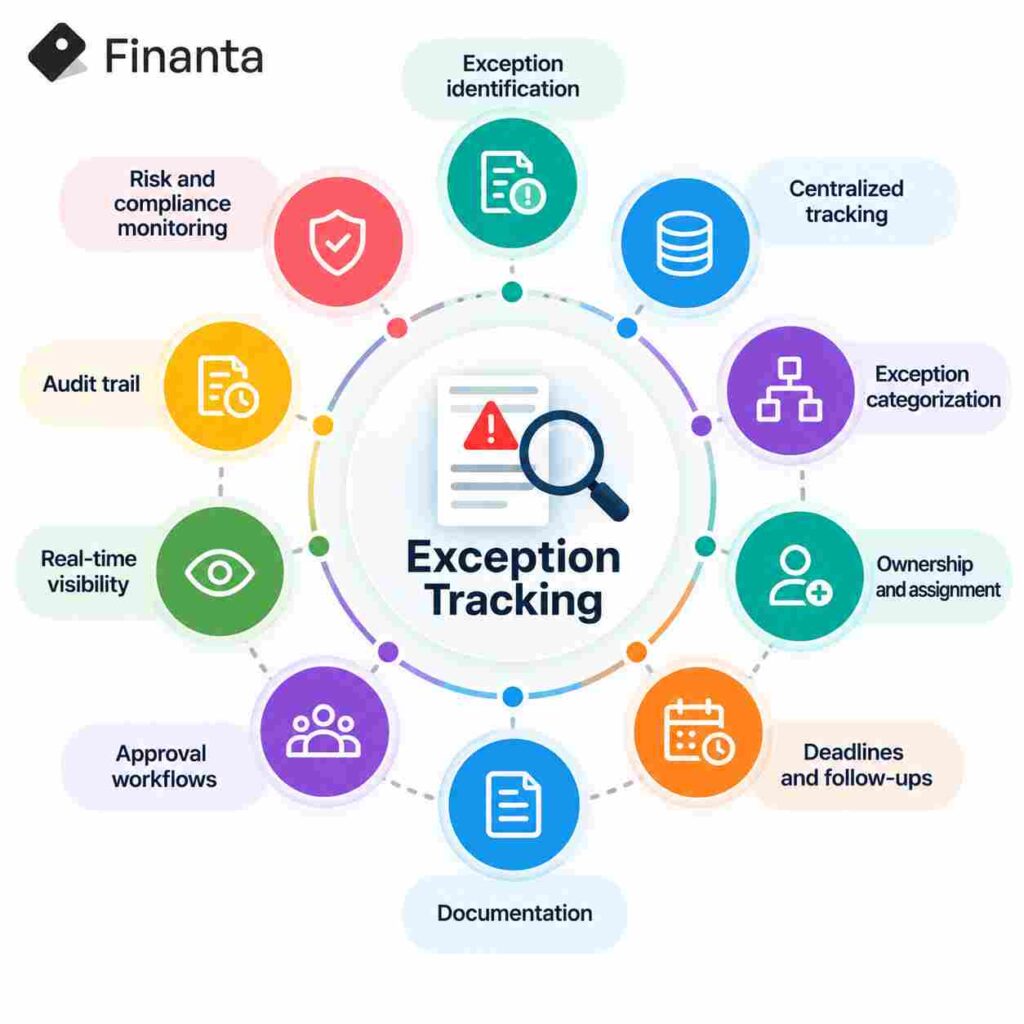
Key Elements of Exception Tracking
Exception identification: Automatically or manually identify deviations from lending policies, requirements, or workflows.
Centralized tracking: Maintain all loan exceptions in one location instead of relying on spreadsheets, emails, or manual notes.
Exception categorization: Classify exceptions by type, severity, borrower, loan, department, or policy requirement.
Ownership and assignment: Assign each exception to the appropriate lender, credit officer, or operations team member.
Deadlines and follow-ups: Set due dates and reminders to ensure exceptions are resolved on time.
Documentation: Record supporting documents, comments, approvals, and resolution details.
Approval workflows: Route exceptions requiring management or credit committee approval to the appropriate decision-makers.
Real-time visibility: Give lenders a current view of open, pending, overdue, and resolved exceptions.
Audit trail: Maintain a history of who identified, reviewed, approved, and resolved each exception.
Risk and compliance monitoring: Help lenders identify recurring exceptions and potential policy or compliance risks.
Effective exception tracking allows banks, credit unions, and other commercial lenders to manage lending exceptions without losing visibility or control. Instead of allowing exceptions to remain buried in emails or spreadsheets, lenders can create a structured process for reviewing, approving, resolving, and documenting them throughout the loan lifecycle. This can help improve operational efficiency while supporting stronger credit risk management and compliance.
Two Types of Exceptions, Two Different Management Disciplines
Most lending teams use the word “exception” to mean everything from a below-policy DSCR approved at origination to a missing insurance certificate on a five-year-old loan. Treating these as the same category is one of the most common and most costly exception management mistakes in commercial lending.
There are two distinct types. Understanding the difference changes how you manage each one.
Policy exceptions are underwriting deviations approved at origination. A loan approved with a debt service coverage ratio below the policy minimum. A borrower accepted with collateral outside standard guidelines. A concentration limit deviation documented and signed off by the credit committee. These are deliberate risk decisions made with eyes open. They require documented approval at the right authority level, a clear rationale for the deviation, and ongoing monitoring to ensure the exception does not quietly become a performance problem. A policy exception on a below-minimum DSCR loan that subsequently defaults was a loan the institution should have been watching differently from day one, not just approving and filing.
Documentation and tickler exceptions are a different animal entirely. These arise during the loan lifecycle:
Missing annual financial statements
Overdue covenant compliance certificates
Lapsed insurance certificates
Expired flood certifications
Outstanding appraisal updates
Delinquent borrowing base certificates
These are not underwriting judgments. They are ongoing administrative and compliance obligations that accumulate as loans age. They require systematic tracking, consistent follow-up, and clear escalation paths when they are not resolved on time.
The management implication of conflating the two is significant. Institutions that run both types through the same tracking process apply the wrong approval logic to documentation items, miss the regulatory reporting distinctions between them, and produce exception reports that mix underwriting risk signals with documentation compliance gaps. The result is a report that is not actionable for either purpose and an examiner who has to sort it out themselves.
What is the Difference Between a Policy Exception and a Documentation Exception?
A policy exception is an underwriting deviation approved at origination. A documentation exception is an administrative or compliance obligation that goes unmet during the loan lifecycle. Policy exceptions are deliberate risk decisions. Documentation exceptions are process failures. Managing both through one workflow is the most common and most costly mistake in commercial loan exception management.
A policy exception on a below-minimum DSCR loan that later defaults was a loan the institution should have been watching differently from day one, not approving and filing.
Institutions that run both types through one process apply credit-committee approval logic to insurance certificates, miss the regulatory reporting distinctions between the two categories, and produce exception reports that blend underwriting risk signals with documentation compliance gaps. The result serves neither purpose, and an examiner has to separate them for you.
What Regulators Expect and Why It Matters More Than Most Institutions Realise
The OCC Comptroller’s Handbook on Credit Administration addresses exception tracking explicitly as a component of sound credit risk management. Examiners use it as a direct reference during commercial loan examinations, and what they are looking for is specific.
Three things consistently draw examiner attention. First, exception volume relative to portfolio size and whether concentration patterns exist by loan officer, loan type, or collateral category. An institution with a high exception volume is not automatically in trouble. An institution that cannot tell you where those exceptions are concentrated almost always is. Second, exception aging and whether management is demonstrably acting on what its own reports show.
A report produced and filed is not evidence of management. A report produced, distributed to the right people, and followed by documented action is. Third, the content of board and senior management reporting. Regulators expect exception reports to reach appropriate oversight levels with enough granularity to enable meaningful review. A report that shows a total count without aging, concentration, or trend analysis does not meet that standard. If your board exception report shows only a number, it is not what examiners are looking for.
What Poor Exception Management Is Actually Costing You
This is not a theoretical argument. These costs are accumulating at your institution right now if your exception management process is running on spreadsheets and manual follow-up.
The credit quality cost is the most consequential. Documentation exceptions that age without resolution are early warning signals for deteriorating credits. A borrower who stops submitting financial statements is frequently a borrower whose financial position is deteriorating. A borrower who misses covenant compliance certifications may be a borrower who knows they are in breach and is hoping no one notices. A borrower whose insurance lapses may be a borrower managing a cash flow problem that has not yet surfaced in their financials.
Institutions managing these as documentation housekeeping items are missing the early warning function that exception tracking is supposed to serve. They are discovering the same credits in worse condition, with fewer workout options, at the next scheduled review. That is not a documentation problem. It is a credit quality problem. The loan portfolio management argument made earlier in this series applies directly here: the earlier a lender sees the signal, the more options both the lender and the borrower have.
The regulatory cost is the most visible. Exam findings on exception management generate remediation requirements and management action plans. They consume management time and institutional resources that would far exceed the cost of a functioning exception management process. More consequentially, an institution that walks into an examination with exception concentration patterns it has not identified itself is in a weaker position than one that identified the same patterns through its own monitoring and can demonstrate it acted on them. The difference between those two examination conversations is significant.
The operational cost is the most chronic. Managing exceptions manually across a large commercial book consumes credit operations capacity that should be going to judgment-level credit work. Chasing borrowers for documents. Tracking resolution status across spreadsheets. Producing exception reports by hand. Institutions using Finanta’s platform have achieved a 40% improvement in operational efficiency and a 65% reduction in processing errors across the lending lifecycle. That recovered capacity does not just reduce overhead. It goes back to monitoring credits, identifying early warning signals, and managing relationships. That is a credit quality benefit, not just an administrative one. See the specifics here.
The Four Ways Manual Exception Tracking Fails
Most institutions do not have a broken exception management process. They have a process that was adequate for a smaller, slower book and has not scaled with the portfolio. Here is where it breaks down.
Exception accumulation without aging visibility. The tracking system shows what exceptions exist. It does not show how long they have existed or whether they are getting older rather than being resolved. A spreadsheet with four hundred exceptions looks identical whether those exceptions are thirty days old or three hundred days old. The aging dimension is where the credit quality signal lives. It is invisible without a system that tracks it automatically.
No escalation workflow. Exceptions are logged and assigned. There is no systematic mechanism that routes aging exceptions to a supervisor when they pass a defined threshold. Resolution depends on individual relationship manager follow-through. The exceptions that age the longest are frequently in the books managed by relationship managers with the heaviest workloads, which is exactly the concentration pattern the examiner in the opening scenario found.
Policy and documentation exceptions managed through the same workflow. Documentation items get routed for credit committee review they do not require. Policy exceptions that need ongoing performance monitoring are filed alongside missing insurance certificates. The report that results serves neither purpose well and prepares management for neither examiner conversation.
Exception pattern analysis absent. Each exception is managed in isolation. The concentration by loan officer, loan type, or collateral category that an examiner constructs in twenty minutes from aggregate exception data is invisible to internal management until someone builds the same analysis manually. Most institutions do this only when preparing for an examination. By then, the concentration has already been developing for months.
What Effective Exception Management Looks Like, and How Finanta Delivers It
Here is what a properly functioning exception management system needs to do, and how Finanta addresses each requirement specifically.
Separate workflows for separate exception types. Finanta’s exception management module handles policy exceptions and documentation exceptions through distinct workflows, approval routing, and reporting formats. Each exception type follows the process it actually requires rather than a generic administrative path that serves neither type well.
Automated escalation based on age and type. Finanta’s workflow automation routes aging exceptions to the appropriate supervisor with built-in escalation logic. Resolution is driven by the system rather than by individual follow-through. The exceptions that would previously have aged the longest in a manual process are the ones the system flags earliest for supervisory attention. The relationship manager who lets exceptions accumulate gets a supervisor alert, not just a growing spreadsheet row.
Exception reports that show what management and examiners actually need. Finanta’s exception reports by type and balance produce reports showing:
Exception composition by category (policy versus documentation)
Aging buckets (current, thirty to sixty days, sixty to ninety days, over ninety days)
Resolution rates by exception type and by relationship manager
Concentration patterns by loan officer, loan type, and collateral category
This is the same portfolio-level pattern view that an examiner constructs during an examination, available as a routine management tool through reporting and analytics rather than something assembled under examination pressure.
Portfolio-level exception pattern analysis running continuously. Finanta’s exception tracking capability surfaces concentration patterns across the book simultaneously with individual exception management. The institution identifies its own exception concentrations before an examiner does, with enough lead time to act on them, rather than discovering them during the examination itself.
Institutions including IBC Bank, which partnered with Finanta to modernise their commercial lending operations, trust the platform to manage the operational complexity of a growing commercial book. The outcome of moving exception management onto a purpose-built platform is not just a cleaner audit trail. It is a credit team that spends its time on credit work rather than document chasing, an examiner conversation that starts from demonstrated process strength, and an early warning system that is actually functioning rather than existing on paper.
See how Finanta’s exception tracking and tickler management module works in practice. Book a personalized demo → and bring your current exception volume and process to the conversation.
Conclusion: Your Exception Process Either Finds Problems Before Your Examiner Does, or It Doesn’t
Exception tracking in commercial lending is a credit quality discipline, a regulatory examination management function, and an operational efficiency lever. The institutions that manage it as all three simultaneously, rather than as documentation housekeeping, carry a meaningfully different risk profile and spend their credit teams’ time differently. The gap between those two operating models is not a technology gap. It is a process discipline gap that the right technology makes sustainable at scale.
The exception management discipline that runs across the full collateral lifecycle becomes most operationally demanding when the collateral book is diverse. Different asset classes carry different exception types, different resolution timelines, different regulatory implications, and different monitoring requirements. Managing that complexity across CRE, equipment, agricultural assets, and receivables simultaneously is what the next piece in this series addresses directly.
Your exception management process either finds problems before your examiner does or it doesn’t.Book a demo to see what the difference looks like in practice.
Found this useful?Share it with your team and network.
What is the difference between a policy exception and a documentation exception and how should each be reported to the board?
Policy exceptions reflect approved underwriting deviations, while documentation exceptions are ongoing administrative gaps. Board reports should distinguish them, detailing rationale and monitoring for policy exceptions, and aging, trends, resolution rates, and manager concentrations for documentation exceptions to support effective oversight.
What should a sound loan exception policy include to satisfy OCC and FDIC examination standards?
A sound loan exception policy should define exception types, establish approval authorities, set monitoring requirements, specify escalation thresholds, prescribe board reporting cadence and content, and track trends over time. These components promote consistent classification, accountability, timely escalation, and effective examiner oversight.
How should exception aging thresholds be set and what should trigger escalation?
Documentation exceptions generally require follow-up within 30 days, supervisory escalation at 60–90 days, and senior management notification beyond 90 days, calibrated by risk. Policy exceptions should follow annual reviews and condition-based triggers, with earlier escalation for significant credit-quality signals.
How do examiners use exception data to assess credit quality beyond the compliance dimension?
Examiners view exception reports as credit quality indicators. Concentrations, aging patterns, and recurring exceptions can reveal credit administration weaknesses or borrower deterioration. Monitoring trends continuously—especially missing financials, lapsed covenants, and expired insurance—helps institutions identify risks earlier and demonstrate stronger oversight.
What does the transition from manual to automated exception tracking look like operationally and how long does it take?
A commercial loan exception tracking platform typically reaches steady state within 60–90 days: 30 days for migration and workflow setup, 30 days for parallel validation, and final decommissioning of manual processes. The key shift is from reactive chasing to proactive monitoring.
What is exception tracking in commercial lending?
Exception tracking in commercial lending is the process of recording, categorizing, monitoring, escalating, and resolving policy and documentation exceptions throughout the commercial loan lifecycle. It helps lenders track outstanding requirements, monitor aging, assign responsibility, and identify patterns across their loan portfolios.
Why is exception tracking important for commercial lenders?
Exception tracking helps commercial lenders monitor unresolved documentation requirements, identify potential risk signals, improve management visibility, and support consistent follow-up. Effective tracking can also help institutions prepare more organized reporting for internal oversight and regulatory examinations.
What are the main types of exceptions in commercial lending?
The two broad categories are policy exceptions and documentation or tickler exceptions. Policy exceptions involve approved deviations from underwriting or credit policy. Documentation exceptions involve outstanding loan lifecycle obligations, such as missing financial statements, overdue covenant certificates, or expired insurance documentation.
What is the difference between exception tracking and exception management?
Exception tracking focuses on recording and monitoring outstanding items, including their ownership, deadlines, and status. Exception management includes the broader processes for categorization, prioritization, escalation, resolution, reporting, and oversight. Tracking is one component of effective exception management.
What is loan tickler management?
Loan tickler management is the process of tracking recurring or scheduled loan-related requirements, such as financial statement submissions, insurance renewals, covenant certificates, and appraisal updates. Tickler management helps lenders monitor due dates and follow up on outstanding documentation.
What is a tickler system in banking?
A tickler system is an automated reminder mechanism that flags upcoming and overdue loan requirements: annual financial statements, covenant compliance certificates, insurance and flood certifications, appraisal updates, and borrowing base certificates. Modern tickler management systems add escalation logic, so an item passing a defined age threshold routes automatically to a supervisor.