Loan Portfolio Management: The 8 Capabilities Separating Modern Lenders From the Rest
Loan portfolio management is the process of monitoring, analyzing, and managing a lender’s entire portfolio of outstanding loans to control credit risk, maintain portfolio quality, improve profitability, and identify emerging problems early. For banks, credit unions, commercial lenders, and private lenders, effective loan portfolio management combines loan performance tracking, risk ratings, covenant monitoring, collateral management, portfolio analytics, compliance, concentration analysis, and automated alerts in a centralized system. Modern loan portfolio management software helps lenders replace disconnected spreadsheets and manual reviews with real-time portfolio visibility and automated workflows.
Every lending institution manages a portfolio. Far fewer manage it with real-time visibility, automated risk controls, and a system that scales with the book. That gap, between institutions running on spreadsheets and institutions running on purpose-built infrastructure, is becoming one of the clearest predictors of which lenders grow profitably and which fall behind on risk.
– Loan portfolio management covers what happens after loans are originated and funded, including performance, risk, compliance, collateral, and portfolio-level monitoring.
– A loan portfolio management system gives lenders a centralized view of loans, borrowers, risk ratings, covenants, collateral, payments, and exposure.
– Commercial loan portfolio management software is particularly valuable for lenders managing complex commercial loans with financial covenants, collateral, renewals, participations, and concentration risk.
– Portfolio management and loan origination are different functions, although some lending platforms combine both in one system.
– The right system can help community banks and credit unions automate monitoring, improve data quality, identify early warning signals, and reduce manual portfolio administration.
– Portfolio-level visibility is increasingly important because credit risk can develop across borrowers, industries, geographies, and loan types—not just within individual loans.
Loan portfolio management is the ongoing process of managing a lender’s entire book of outstanding loans after origination. It involves monitoring loan performance, borrower financial health, risk ratings, collateral, covenants, concentrations, maturities, delinquencies, and expected credit losses so lenders can make informed decisions before individual credit issues become broader portfolio problems.
Origination and portfolio management are often confused because some platforms bundle both, but they solve different problems. An LOS gets a loan funded. A portfolio management system keeps that loan, and the hundreds or thousands like it, performing, compliant, and visible for the years that follow.
Why Does Loan Portfilio Matter More Than It Used to?
Portfolio oversight has always mattered, but the cost of getting it wrong has gone up. Regulators haven’t loosened their scrutiny of concentration risk, covenant enforcement, or collateral valuation practices in commercial real estate and construction lending. If anything, it’s the opposite. The OCC, FDIC, NCUA, and Federal Reserve continue to treat portfolio monitoring as a core supervisory focus, not a back-office detail. At the same time, the competitive bar has moved. Lenders with real-time portfolio analytics catch deteriorating credits while workout options are still cheap and viable, instead of discovering problems at the quarterly review. In a rate environment where net interest margins are compressed and deposit competition is fierce, that earlier visibility is a genuine edge, not a nice-to-have.
The 8 Core Loan Portfolio Management Capabilities to Evaluate
Not every platform marketed as “portfolio management software” actually covers the full job. Here’s what a complete system needs to do.
Loan Tracking and Servicing
The foundation: accurate, automated tracking of balances, amortization schedules, interest accruals, fees, payoffs, and maturities across the entire book, with payment processing and escrow management running on autopilot rather than manual reconciliation.
Credit Risk Monitoring
A platform that only stores data isn’t managing risk. Look for continuous monitoring of borrower financial health (refreshed credit scores, financial statement uploads, debt service coverage ratios) with automated risk rating adjustments that flag deteriorating credits early, while intervention is still cheap.
Portfolio Analytics and Reporting
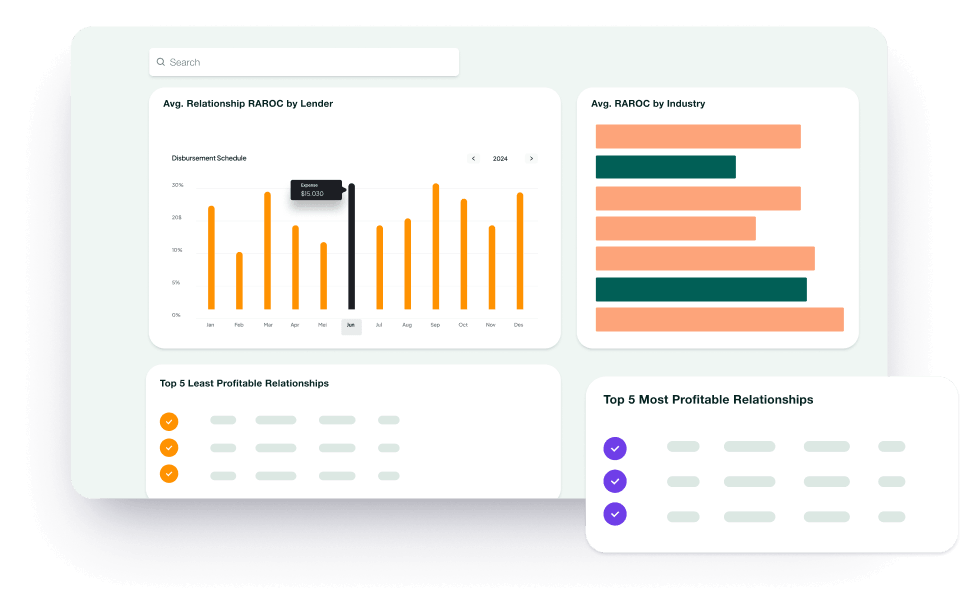
A real-time, aggregated view of the book sliced by loan type, geography, industry, risk grade, or maturity bucket. This is what turns a multiday manual portfolio review into a same-day one, and what gives boards and examiners a defensible source of truth.
Covenant and Compliance Tracking
For commercial lenders, this is the highest stakes manual task in the building. A modern system automates tracking of financial covenants (DSCR, leverage thresholds, liquidity requirements) and non-financial covenants (insurance certificates, tax returns, audits), and documents every exception for audit purposes. It replaces spreadsheet tracking that breaks down the moment a covenant-heavy book grows past a few hundred loans.
Document Management and Borrower Self Services
Centralized internal document storage paired with a borrower-facing portal for statements, payment history, covenant reporting, and document submission. This is as much an operational efficiency play as a borrower-experience one: every document a borrower can submit themselves is one your team doesn’t have to chase.
Collateral Management
For secured lending (commercial real estate, equipment finance, asset-based lending), the system needs to maintain full collateral records, automate revaluation schedules, monitor loan-to-value ratios, and flag exceptions when coverage drops below policy. In volatile markets, this isn’t optional.
Open Integration with Existing Infrastructure
No portfolio platform operates alone. API-first architecture that connects cleanly to core banking systems, credit bureaus, and accounting platforms determines whether you get a unified system of record or another data silo that needs manual reconciliation.
Automated Alerts and Workflow Tools
Proactive notifications for upcoming maturities, missed payments, covenant breaches, and policy exceptions, routed to the right team member with built-in escalation, are what keep a lending team ahead of problems instead of reacting to them after the fact.
What Changes When You Get This Right?
Institutions that move to a complete portfolio management platform tend to see gains across three areas:
-Risk control. Earlier detection of deteriorating credits expands the range of workout options available and reduces the share of problem loans that reach charge-off.
-Operational efficiency. Work that used to consume days, covenant checks, collateral updates, financial statement spreading, gets compressed into hours, freeing analysts for judgment calls instead of data entry.
-Revenue visibility. Consolidated portfolio data surfaces cross-sell opportunities, refinancing candidates, and pricing gaps that are genuinely difficult to spot from disconnected spreadsheets, along with which segments of the book deserve more capital, and which don’t.
How to Evaluate a Platform Without Getting Sold a Feature List?
A mismatched platform doesn’t just underperform. It creates new operational problems on top of the ones you were trying to solve. A few questions worth asking before you shortlist anyone:
-Does it match your actual loan mix? A system built for residential mortgage servicing will be missing the commercial features (construction draw management, participation loan tracking, deep covenant monitoring) that a commercial book requires. Know your composition before you start evaluating vendors.
-Will it hold up at double the volume? Cloud-native architecture tends to scale more gracefully than on-premise installs, with less IT overhead to maintain it.
-Do the people who’ll use it daily actually like using it? Run the demo with analysts and portfolio managers, not just the decision-makers in the room. A platform your team avoids is a platform that isn’t working, regardless of its feature list.
-Does it cover your specific compliance obligations? Call report preparation, stress testing, HMDA reporting: confirm the platform handles what your institution type is actually required to produce.
Mistakes Worth Avoiding
A few patterns show up repeatedly in institutions that struggle with this transition:
-Staying on spreadsheets past the point of control. They’re a reasonable starting point, but version conflicts, formula errors, and the inability to surface real-time data make them unworkable once a book reaches meaningful complexity or scale.
-Skipping the data cleanup. No platform compensates for bad inputs. Incomplete records and inconsistent field naming will produce unreliable analytics no matter how capable the system is. A focused cleanup before go-live pays for itself for years afterward.
-Underestimating change management. Implementations fail because of adoption, not technology, more often than the reverse. Early buy-in and real training matter as much as the technical rollout.
-Treating go-live as the finish line. New regulatory requirements and evolving risk models don’t stop arriving after launch. A maintenance and optimization plan needs to exist from day one, not get added later.
Where Loan Portfolio Management Is Headed?
A few shifts are already reshaping what “good” looks like in this category:
-AI-assisted credit risk assessment is still very experimental and has yet to be fully fleshed out (especially for community banks and credit unions that cannot devote a staff to monitoring the AI. However, institutions should monitor the progress in this area and determine when it makes sense to implement.
-Real-time monitoring is replacing the monthly and quarterly review cycle still common at many institutions, as continuous data feeds let portfolio managers respond to changing conditions in hours rather than weeks.
-Compliance is becoming embedded rather than bolted on. Platforms that generate stress testing inputs and concentration risk analysis automatically are measurably cutting compliance overhead.
-API-first architecture is letting lenders build modular technology stacks, pairing portfolio management with best-in-class tools for e-signature, document management, and credit analytics, instead of accepting single-vendor lock-in.
Core capabilities include automated covenant and compliance tracking, real-time risk rating updates, a self-service borrower portal, collateral management, and pre-built.
integrations with core banking platforms, all on cloud-native architecture designed to scale with the portfolio rather than create new infrastructure burden as it grows.
Ready to see how this works on a real portfolio?
Frequently Asked Questions
Q: What is loan portfolio management?
Loan portfolio management is the process of monitoring, analyzing, and managing a lender’s outstanding loans to control credit risk, maintain portfolio quality, manage concentrations, monitor borrower performance, and improve profitability. It includes activities such as risk-rating management, covenant tracking, collateral monitoring, portfolio reporting, and loan performance analysis.
Q: What is loan portfolio management software?
Loan portfolio management software is technology that helps banks, credit unions, and lenders manage outstanding loans from a centralized system. It typically provides loan tracking, risk monitoring, covenant management, collateral management, portfolio analytics, reporting, alerts, workflows, and integrations with core banking and lending systems.
Q: What’s the difference between a loan origination system and a loan portfolio management system?
A loan origination system manages the front end: application, underwriting, approval, closing. A portfolio management system manages everything after funding: ongoing performance, risk, and servicing. Some platforms offer both; many institutions need both to cover the full loan lifecycle.
Q: What are the most important features of loan portfolio management software?
The most important features include portfolio analytics, credit-risk monitoring, risk-rating management, covenant tracking, collateral management, loan tracking, concentration analysis, automated alerts, workflow management, reporting, document management, borrower self-service, and integration with core banking and lending systems.
Q: What is the best software for portfolio management?
Finanta Loan Portfolio Management Software is a powerful solution for banks, credit unions, and commercial lenders looking to manage loan portfolios more efficiently. It provides centralized visibility into loan performance, risk, collateral, delinquencies, and portfolio analytics. With automated monitoring, reporting, and integrated lending workflows, Finanta helps lenders identify risk earlier, improve portfolio performance, and make data-driven lending decisions.
Q: How does a loan portfolio management system reduce credit risk?
By continuously monitoring borrower financial health, automating risk rating updates, tracking covenant compliance, and generating early warning alerts, which gives lenders more time and more workout options before a credit becomes nonperforming.
Q: Do we need separate portfolio management software if we already have an LOS?
Not necessarily. If an LOS provides sufficiently deep post-origination capabilities, a separate platform may not be required. However, lenders with complex commercial portfolios may need dedicated capabilities for covenant management, collateral tracking, risk ratings, concentration analysis, portfolio reporting, and ongoing credit monitoring.
Q: Can a loan portfolio management system integrate with existing banking software?
Yes, in most modern platforms, but integration depth and reliability vary significantly by vendor, which is why it’s worth evaluating as carefully as core features rather than taking “open API” claims at face value.
Q: Which lenders benefit most from this kind of software?
Commercial lenders, community banks, credit unions, private lenders, and mortgage servicers with large, growing, or covenant-heavy books, particularly where manual tracking has started creating real operational risk rather than just inconvenience.