
On this page
What Are the 5Cs of Credit?
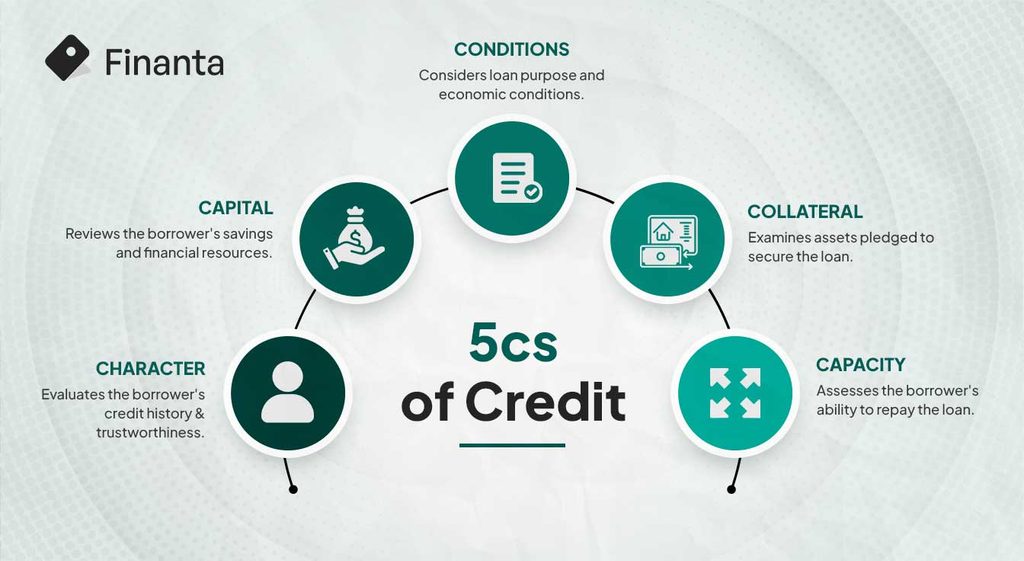
The five Cs of credit are:
- Character: The borrower’s reputation and track record for repaying debts. Lenders look at credit history, credit score, and past repayment behavior.
- Capacity: The borrower’s ability to repay the loan from their income. Lenders check income, employment stability, and the debt-to-income ratio (how much of your income already goes to paying debts).
- Capital: The money or assets the borrower has invested of their own, such as savings, investments, or a down payment. More personal capital shows commitment and lowers the lender’s risk.
- Collateral: Assets the borrower pledges as security for the loan, like a house, car, or gold. If the borrower fails to repay, the lender can take the collateral to recover the money.
- Conditions: The terms of the loan (amount, interest rate, purpose) and outside factors like the state of the economy, industry trends, or government policies that could affect repayment.
Together, these factors provide lenders with a structured way to assess the strengths and risks of a credit application.
1. Character: Evaluating Borrower Reliability
Character refers to a lender’s assessment of a borrower’s financial track record, credibility, and willingness to meet repayment obligations. For a commercial loan, lenders may review the business owner’s credit history, the company’s repayment record, management experience, references, and previous relationships with financial institutions. They may also consider how consistently the business has honored its contractual obligations.
Example: A business that has consistently repaid previous loans on time and has experienced management may demonstrate stronger credit character than a similar business with a history of unresolved defaults.
Why it matters: A borrower’s past financial behavior can help lenders assess repayment reliability. However, credit history is only one part of the evaluation and should be considered alongside current financial performance and other relevant evidence.
2. Capacity: Assessing the Ability to Repay
Capacity measures whether a borrower can generate enough cash flow to repay the proposed loan while meeting existing financial obligations. In commercial lending, capacity analysis often includes reviewing income statements, balance sheets, cash flow statements, existing debt, operating expenses, and financial projections. Lenders may also calculate the debt service coverage ratio (DSCR) to evaluate whether cash flow is sufficient to cover scheduled debt payments.
A common DSCR formula is:
DSCR = Net Operating Income ÷ Total Debt Service
For example, if a business generates $500,000 in annual net operating income and has $400,000 in annual debt service, its DSCR is 1.25x. This means the business generates $1.25 in net operating income for every $1 of debt service. Lenders determine acceptable coverage levels based on their policies, loan structures, and risk appetite.
Why it matters: Even a borrower with valuable assets may face repayment difficulties if its operating cash flow is insufficient. Capacity helps lenders determine whether the proposed loan is financially sustainable.
3. Capital: Understanding Financial Strength
Capital refers to the financial resources and equity a borrower has invested in a business or project, as well as its broader financial capacity to absorb losses. Commercial lenders may examine shareholders’ equity, retained earnings, available cash, leverage, and the relationship between debt and equity. They may also evaluate whether the borrower has sufficient financial reserves to manage unexpected expenses or temporary declines in revenue.
Example: Two businesses apply for financing to expand their operations. One has substantial owner equity and manageable existing debt, while the other relies heavily on borrowed funds. The first business may demonstrate a stronger capital position, depending on the complete credit assessment.
Why it matters: A sound capital position can provide a financial cushion during periods of weaker performance. It can also indicate the extent to which owners have invested their own resources in the business.
Capital is different from capacity: capacity focuses on the ability to generate cash flow for repayments, while capital focuses on financial resources and the borrower’s equity position.
4. Collateral: Evaluating Loan Security
Collateral is an asset pledged to a lender as security for a loan. If the borrower defaults, the lender may have legal rights to enforce its security and recover some or all of the outstanding debt, subject to applicable laws and loan agreements.
In commercial lending, collateral may include:
- Commercial real estate
- Equipment and machinery
- Inventory
- Accounts receivable
- Business assets
- Other eligible assets, depending on the loan structure
Lenders assess collateral value, ownership, condition, liquidity, existing liens, and the ease of enforcing security rights. They may also consider the loan-to-value (LTV) ratio.
LTV = Loan Amount ÷ Appraised Collateral Value × 100
For example, a $700,000 loan secured by property valued at $1 million has an LTV ratio of 70%.
Why it matters: Collateral can reduce a lender’s potential loss if a borrower defaults, but it does not eliminate credit risk. Asset values can decline, and enforcement or liquidation may take time and incur costs.
5. Conditions: Considering the Loan Purpose and Market
Conditions refer to the intended use of loan proceeds and the external factors that could influence a borrower’s financial performance and ability to repay.
Lenders may assess:
- The purpose and structure of the loan
- Industry performance and competitive pressures
- Economic growth and interest-rate trends
- Regulatory or policy changes
- Supply chain and customer concentration risks
- Market demand and projected business performance
Example: A commercial real estate borrower may seek financing for a property in a market experiencing declining occupancy and rental income. Even if the borrower has strong capital and collateral, the market outlook may increase the lender’s assessment of risk.
Why it matters: A borrower’s financial position must be considered in context. Industry trends, economic conditions, and the intended use of funds can affect future cash flow and repayment prospects.
Why Are the 5Cs of Credit Important in Commercial Lending?
The five Cs of credit help financial institutions organize borrower information and assess the overall strength of a lending request. They support several important activities:
- Credit risk assessment: Identify potential repayment challenges and risk factors.
- Loan underwriting: Evaluate financial statements, management credibility, cash flow, and collateral.
- Loan structuring: Help inform loan amount, maturity, security requirements, covenants, and repayment terms.
- Credit decisioning: Support consistent decisions under the institution’s credit policy.
- Portfolio monitoring: Help lenders identify changes in borrower performance and emerging risks after origination.
No single factor necessarily determines the outcome. A lender may consider strong cash flow alongside limited collateral, or evaluate additional security when a borrower has higher leverage. The decision depends on the full risk profile and the lender’s underwriting standards.
How Do Lenders Apply the 5Cs of Credit?
A typical commercial credit evaluation may follow these steps:
- Collect borrower information: Gather loan applications, financial statements, tax records, business details, and supporting documentation.
- Review character: Assess credit history, management background, and repayment behavior.
- Analyze capacity and capital: Examine cash flow, debt service coverage, leverage, equity, and financial reserves.
- Evaluate collateral: Review asset valuations, ownership, liens, and proposed security arrangements.
- Assess conditions: Analyze the loan purpose, industry outlook, market risks, and relevant economic factors.
- Reach a credit decision: Combine the findings with internal risk ratings, underwriting rules, and approval requirements.
- Monitor performance: Track repayment activity, financial results, covenant compliance, and material changes in risk.
The exact process varies by institution and loan type. Lenders may also apply additional criteria, regulatory requirements, and specialized risk models.
How Can Commercial Lending Software Support Credit Analysis?
Commercial lending software can help financial institutions organize information and manage the workflows involved in evaluating the five Cs of credit.
Depending on the platform’s capabilities and configuration, digital lending systems may support:
- Document management: Centralize borrower financial statements, applications, and supporting records.
- Workflow automation: Route credit applications through underwriting, review, and approval stages.
- Financial analysis: Help users access and review borrower financial information.
- Collateral tracking: Maintain information about pledged assets and related documentation.
- Exception management: Record missing information, policy exceptions, and outstanding review items.
- Portfolio monitoring: Support visibility into loan status, borrower information, and ongoing review activities.
For financial institutions handling complex commercial loans, these capabilities can improve process consistency and make relevant borrower information easier to access. Software supports the credit process but does not replace lender judgment, appropriate due diligence, or required approvals.
Finanta provides digital commercial lending capabilities designed to help financial institutions streamline lending workflows and improve access to borrower and loan information. Institutions should confirm specific underwriting workflows and integrations with Finanta.
5Cs of Credit vs. Credit Score
The five Cs of credit and a credit score are related, but they are not the same. A credit score is a numerical indicator derived from a credit scoring model. The five Cs represent a broader framework for evaluating borrower creditworthiness and the strength of a lending request. For example, a business may have a strong credit history but weak current cash flow. The five Cs framework encourages a lender to consider both repayment history and the business’s present ability to service debt.
In commercial lending, a complete credit assessment may include financial analysis, collateral valuation, management evaluation, industry research, credit scores, and institution-specific risk models.