Commercial borrowers today operate in a world where they can open a business account in minutes, get an insurance quote in seconds, and track a freight shipment in real time. Then they apply for a commercial loan and find themselves emailing tax returns, waiting days for a status update, and calling a relationship manager just to find out if their application is moving. The contrast is not subtle, and borrowers are noticing.
The Federal Reserve Banks’ 2024 Small Business Credit Survey, fielded across more than 7,600 small employer firms, found that net satisfaction with lenders among financing applicants declined overall between 2023 and 2024. That is not a rounding error. It is a directional signal about how borrowers feel about the institutions they rely on at the most consequential financial moments of their business lives.
This decline in commercial lending borrower satisfaction is not inevitable, and the lenders who understand its root causes are already reversing it.
The Numbers That Should Concern Every Lender
The headline figure from the Fed survey is striking enough on its own: net satisfaction with online lenders collapsed from 15% to 2% in a single year. But the more revealing trend is the shift in application behavior. Application rates at large banks fell from 44% to 39% year over year. Borrowers are not just dissatisfied; they are quietly redirecting their business.
It is tempting to read these numbers as a fintech problem or a large-bank problem. They are neither. They reflect a broad erosion of trust in the lending experience itself, and no institution category is immune. When borrowers become comfortable shopping across lender types and rate their experience as the deciding factor, the lenders that have not invested in that experience become vulnerable regardless of their balance sheet strength or brand reputation.
What the J.D. Power 2025 U.S. Mortgage Origination Satisfaction Study makes clear is that the driver of satisfaction is not primarily technology, it is timing and communication. Lenders who engaged borrowers before active shopping began scored 32 points higher on satisfaction than those who first made contact at the application stage. Lenders who waited until the application to engage saw satisfaction drop by 64 points. The borrower who already feels guided and informed when they submit their application has a fundamentally different experience than the one who feels processed. While this study targeted borrowers for mortgage loans, the parallels to commercial lending are direct.Technology enables that guidance at scale, but the decision to engage early is a strategic choice, not a software feature.
What Borrowers Are Actually Experiencing in Commercial Lending
Behind the survey numbers is a recognizable pattern that any lender who has walked through their own origination process will find uncomfortable to read.
A business owner applies for a commercial line of credit. She submits her application and hears nothing for four days. She emails her relationship manager, who is in back-to-back meetings. She eventually learns that her application is underwriting, but that several documents are still needed, documents she thought she had already provided. The requests arrive one at a time over the following week, each one requiring her to locate, scan, and email another file. There is no single place to see what is outstanding, no confirmation that documents have been received, and no visibility into where the application stands unless she calls.
This is not hypothetical. It is the standard experience at a significant share of commercial lending institutions. The friction points that surface consistently across Finanta’s work with lenders are: limited visibility into loan status, balances, and escrow; document exchanges scattered across email threads; slow handling of routine requests like payoff letters and ACH updates; no proactive communication when payments are due or documents are missing; no role-based access for business borrowers whose CFO, accountant, and ownership team all need to be involved; and siloed systems that require manual data refreshes rather than live, integrated information.
Each of these is individually frustrating. Collectively, they produce a borrower who feels that their lender is disorganized, unresponsive, and, in the worst cases, not worth working with again. The lenders who have deployed a genuine borrower self-service portal have eliminated most of these friction points not by working harder but by building the infrastructure that makes them structurally impossible.
The Digital Illusion: Why Having a Portal Is Not the Same as Having a Process
The Digital Banking Report’s State of Digital Lending found that web-based loan applications are now available at 90% of financial institutions, up from 75% in 2019. At first glance that looks like progress. Looking at it more carefully, it is mostly a facade.
Fewer than 50% of those institutions could handle their products digitally from end to end, and where digital processes did exist, the report found them often slow and disjointed. A borrower who submits an application through an online form and then receives document requests by email has not had a digital experience. They have had a paper process with a digital front door. The login screen is not the product. The process behind it is.
This distinction matters because many lenders have convinced themselves that deploying a web application means they have addressed the commercial lending borrower satisfaction problem. The FDIC’s 2024 Small Business Lending Survey reinforces the point more precisely: only 24% of small banks and 42% of large banks accepted small business loan applications online, and even among those that did, the vast majority could not complete the process digitally. Document submission, financial statement collection, and supporting information gathering still required in-person or email-based exchanges. The result is a fragmented experience with multiple handoff points, each one carrying the potential for delay, miscommunication, and the slow accumulation of borrower frustration that shows up in satisfaction surveys a year later.
The gap between having a digital front door and offering a genuinely seamless digital process is precisely where most lenders live. It is also where the opportunity is largest for institutions that decide to close it.
The Lenders Who Are Getting It Right
The J.D. Power data makes the business case plainly. Borrowers who received top scores for useful guidance from their lender throughout the process were 2.3 times more likely to say they would definitely choose the same lender for their next loan. Overall satisfaction rose 33 points among lenders who adopted advisory-style engagement. The return on a better borrower experience is not soft or anecdotal. It compounds directly into retention and repeat volume.
What does this look like in practice? IBC Bank, managing an $8.8 billion loan portfolio across 15,000 loan records, deployed Finanta’s commercial lending platform to modernise its origination and servicing operations. The results were measurable across every dimension that matters. IBC funded 2,000 new loans and renewed 1,600 existing loans, achieving 8.9% year-over-year loan growth. Funding cycle time fell by 30%, directly compressing the wait that is one of the most consistent sources of borrower frustration. The bank’s Audit Readiness Index improved by 34 percentage points, reflecting the kind of structured regulatory compliance posture that examiners increasingly expect and that borrowers experience as reliability and accountability.
“By leveraging Finanta’s comprehensive commercial lending solutions suite, IBC Bank will not only enhance their operational efficiencies but also provide their clients with superior lending products and services tailored to the dynamic commercial lending sector.”Dalia F. Martinez, EVP Corporate Operations, IBC Bank.
The operational gains and the borrower experience improvements are not separate outcomes. They are the same outcome viewed from two sides. When borrowers receive complete document checklists at intake rather than piecemeal requests over two weeks, when they can see their application status without calling, when their relationship manager is spending time on credit judgment rather than chasing paperwork, commercial lending borrower satisfaction improves measurably. That difference registers in renewal rates, in referrals, and in the compounding portfolio growth that IBC Bank’s numbers reflect.
See how the Finanta platform delivers these results at your institution. Book a demo to speak with our team.
What Lenders Need to Change to Improve Borrower Satisfaction?
The evidence points to four specific operational changes that have the clearest direct impact on commercial lending borrower satisfaction. These are not technology recommendations in the abstract. They are the specific gaps that show up in borrower feedback and satisfaction surveys, and each one maps to a capability that Finanta’s customers have deployed to measurable effect.
The first is shifting engagement earlier. The J.D. Power data shows a 32-point satisfaction gap between lenders who engage borrowers before they start shopping and those who wait for the application. Finanta’s platform supports this through deal capture and CRM integration that allows relationship managers to track prospects, schedule outreach, and maintain a 360-degree view of the customer relationship before an application is ever submitted. Engaging early is not just a cultural change; it requires a system that makes early-stage borrower information visible and actionable.
The second is replacing fragmented document collection with a structured self-service intake process. Document incompleteness is the single most common cause of extended cycle times in commercial lending, according to the FDIC survey. Finanta addresses this through dynamic document checklists that are generated at the point of application based on loan type, size, and borrower characteristics, validated for completeness before submission, and tracked in real time so both the borrower and the lender know exactly what has been received and what is still outstanding. The result is a 40% efficiency boost in commercial loan origination and a 30% reduction in funding cycle time reported by Finanta customers.
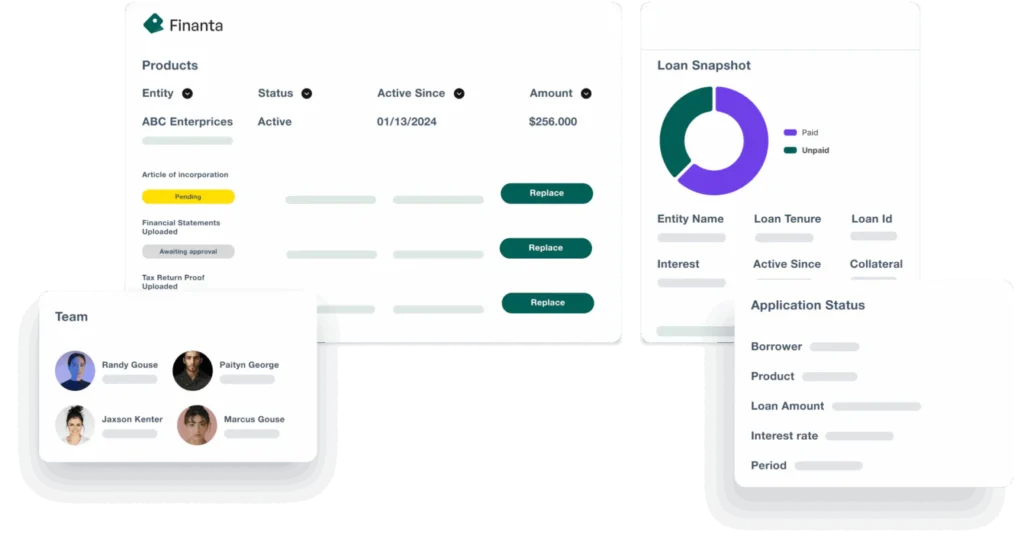
The third is giving borrowers real-time visibility into their application status. This is a table-stakes expectation in any consumer digital experience, and its absence in commercial lending is the most consistent complaint in satisfaction research. Finanta’s borrower portal provides live application tracking, automated notifications when the application moves between stages, and secure in-platform messaging that keeps every communication tied to the loan file rather than scattered across email threads.
The fourth is treating the post-funding period as a relationship continuation, not a cost centre. Commercial loan servicing that proactively surfaces renewal opportunities, flags covenant exceptions early, and keeps borrowers informed through the life of the loan builds the kind of trust that drives repeat business. Finanta customers have reported a 55% increase in loan volumes after deployment, a figure that reflects not just origination efficiency but the compounding effect of borrowers who return and refer because the experience at every stage met their expectations.
Borrower expectations are not set by other lenders. They are set by every well-designed digital experience borrowers have in the rest of their lives, and the bar rises every year. Commercial lending borrower satisfaction will continue to decline for institutions that treat the application as the beginning and the funding as the end. The institutions that will retain and grow commercial borrower relationships are those that understand this shift and build operations accordingly. Finanta was built specifically for this moment: to give banks, credit unions, and non-bank lenders the platform to deliver the experience borrowers now expect, without sacrificing the relationship intelligence that remains their core competitive advantage. The gap is real, the tools to close it exist, and the lenders who move first will be the hardest to displace.
See How Finanta Helps Lenders Close the Confidence Gap
Finanta is a unified commercial lending platform built for banks, credit unions, and non-bank lenders ready to compete on borrower experience. From origination through servicing, Finanta gives lending teams the infrastructure to engage earlier, process faster, and retain more.
Q: Why is commercial lending borrower satisfaction declining?
The Federal Reserve Banks’ 2024 Small Business Credit Survey found that net satisfaction with lenders declined overall between 2023 and 2024, with the sharpest drop at online lenders where net satisfaction fell from 15% to 2% in a single year. The primary drivers are a lack of transparency into application status, fragmented document collection, and reactive rather than proactive communication. Borrowers are comparing their lending experience to the polished digital services they use daily, and most commercial lending processes fall well short of that standard.
Q: What do commercial borrowers want from their lenders today?
Research consistently points to three things: early engagement before they start actively shopping, real-time visibility into their application and loan status, and communication that is proactive rather than reactive. The J.D. Power 2025 study found that borrowers who receive top-quality guidance from their lender are 2.3 times more likely to return for their next loan. Transparency and responsiveness matter more to commercial borrowers than rate alone.
Q: How does a borrower portal improve commercial lending borrower satisfaction?
A genuine borrower portal replaces fragmented email-based document collection with a structured, self-service environment where borrowers can submit applications, upload documents, track their application status in real time, and communicate with their lending team from a single interface. It eliminates the most common friction points in commercial lending: repeated document requests, opaque status updates, and reactive communication. Lenders who deploy a true borrower portal see higher application completion rates, shorter cycle times, and measurable improvements in borrower satisfaction.
Q: What is the difference between a digital loan application and a true borrower portal?
A digital loan application is a form that collects information at the point of submission. A true borrower portal supports the entire lending lifecycle, from application through underwriting, closing, and ongoing servicing. The FDIC’s 2024 survey found that while 42% of large banks accept loan applications online, fewer than half could handle the process digitally end to end. The gap between those two numbers is exactly what separates a digital front door from a genuine borrower experience.
Q: How can lenders improve borrower satisfaction in commercial lending?
Improving commercial lending borrower satisfaction requires four operational changes: engaging borrowers earlier in their journey before they start actively shopping, replacing piecemeal document requests with a structured self-service intake process, providing real-time application status visibility, and treating post-funding communication as part of the ongoing lending relationship. IBC Bank achieved 8.9% year-over-year loan growth and a 30% reduction in funding cycle time after deploying Finanta’s commercial lending platform, demonstrating that operational improvements and borrower experience improvements are the same investment, not competing priorities.
Subscribe Now
Contact our support team for further assistance.
Found this useful?Share it with your team and network.