A borrower portal is a secure online workspace where commercial borrowers upload documents, track loan status, submit financial reporting and message their lender. The features that matter most are guided document collection, real-time loan status, automated reminders, e-signatures, secure messaging, and ongoing covenant and financial reporting. A portal only works if borrowers adopt it, so ease of use matters as much as the feature list.
Borrower portal features include secure document upload, loan application tracking, real-time status updates, automated notifications, digital messaging, payment management, task management, financial document access, and self-service tools, all accessible through the mortgage borrower portal. These features improve borrower engagement, streamline communication, reduce manual work, accelerate loan processing, and provide lenders with greater visibility.
Nine in ten financial institutions now have some form of digital loan application. Yet walk through a commercial borrower’s experience at most of those institutions and the word that comes to mind is not “digital.” It is fragmented. Documents still travel by email. Status updates still require a phone call. Routine requests like payoff letters still land in someone’s inbox and wait.
The gap between “we have a portal” and “our borrowers actually use it and trust it” is where most lenders are stuck, and the gap is almost always a feature problem, not a marketing problem. A borrower portal is only as valuable as the capabilities underneath it. Buying the wrong one is frequently worse than buying none, because it creates a false sense of having solved the problem while the real friction continues underneath.
This guide breaks down the 8 borrower portal features that separate a platform worth buying from one that will still leave your borrowers calling your servicing team — along with the engaging features for loan borrower portals that drive actual day-to-day adoption, not just login-screen adoption.
What is a Borrower Portal?
A borrower portal is a secure, self-service website or app that connects a borrower to their lender during the full loan lifecycle. It replaces email chains, shared drives and phone calls for collecting documents, sharing updates and signing paperwork. In commercial lending, the portal stays in use after closing. Borrowers keep submitting financial statements, tax returns, rent rolls and compliance certificates for years, so a good portal is built for ongoing reporting, not only onboarding.
69% of borrowers used an online portal to upload documents electronically, making it the most-used digital lending tool in ICE’s 2025 survey.
66% of borrowers used online applications and electronic signing/notarization portals.
92% of construction borrowers surveyed by Built said an online portal for budgets, draws, inspections, and documentation is a basic requirement.
Borrower portals can centralize communication, documentation, loan information, and status updates, reducing reliance on email and manual processes.
Digital workflows can also help lenders reduce manual document handling and improve visibility throughout the loan lifecycle.
Why Most Borrower Portals Disappoint
The surface-level adoption numbers look encouraging. The Digital Banking Report’s State of Digital Lending found that 90% of financial institutions now have web-based loan applications, up from 75% in 2019. The FDIC’s 2024 Small Business Lending Survey shows that 42% of large banks and 24% of small banks now accept applications online. Both figures represent real progress.
What those numbers obscure is the depth of that digitization. Fewer than 50% of institutions with online applications could handle their products end to end without reverting to email, in-person exchanges, or manual document collection. Having a login screen is not the same as having a borrower experience. Most institutions have the former and believe they have the latter.
Two failure modes account for the majority of underperforming portals. The first is the siloed portal: a standalone product that does not connect to the institution’s loan management system, which means the data borrowers see is pulled from a separate store and reconciled on a schedule. Borrowers log in and see balances that are three days out of date. The second is the compliance-afterthought portal: one where security and regulatory architecture were layered on after the core product was built, rather than designed in from the start. Both create liability. The end-to-end commercial lending platform that avoids both failure modes is built around integration and compliance architecture from the ground up, not retrofitted to it.
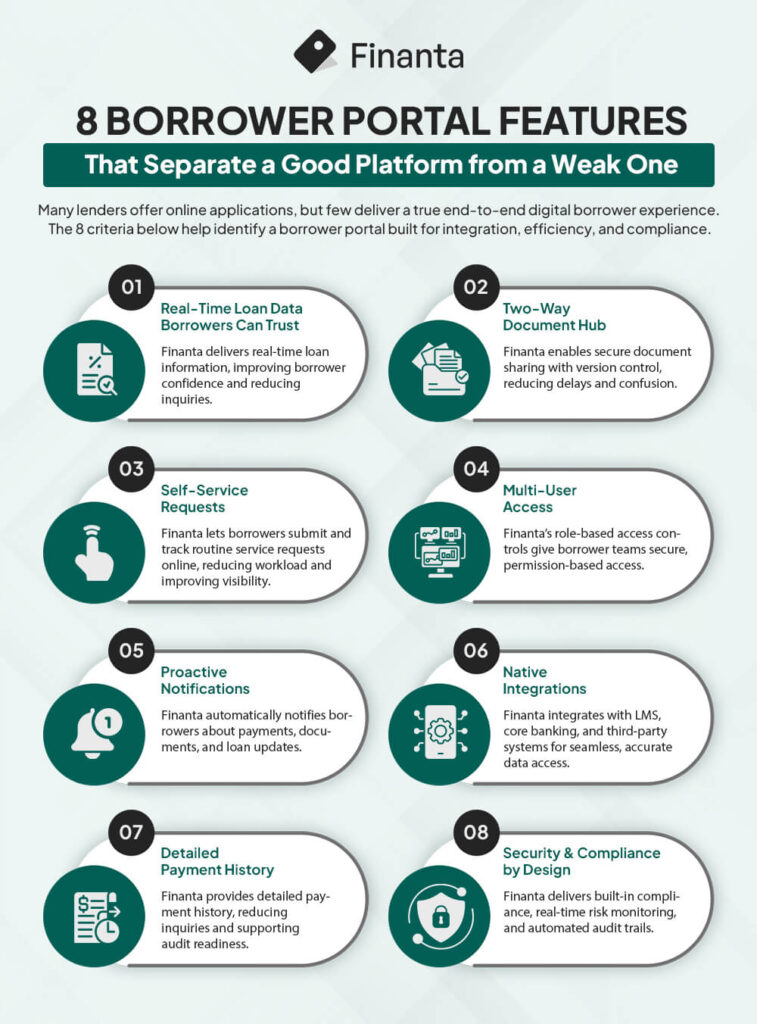
The 8 criteria below are the ones that reveal which category a given portal falls into before you sign a contract.
Key Features of a Borrower Portal
1: Real-time loan data your borrowers can actually trust
The first question to ask any vendor is whether the data a borrower sees in the portal reflects the live system of record or a scheduled sync. A borrower who logs in to check their balance, escrow account, collateral valuation, or upcoming payment schedule and sees figures that are two days old will call. That call is not just a servicing cost; it is a signal that the portal is unreliable, and borrowers who distrust the data stop using the portal entirely.
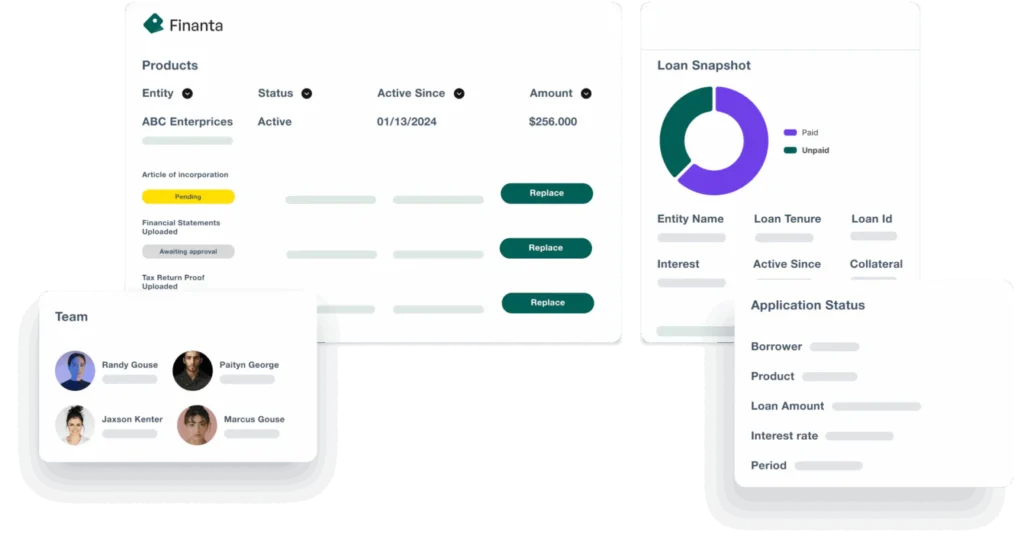
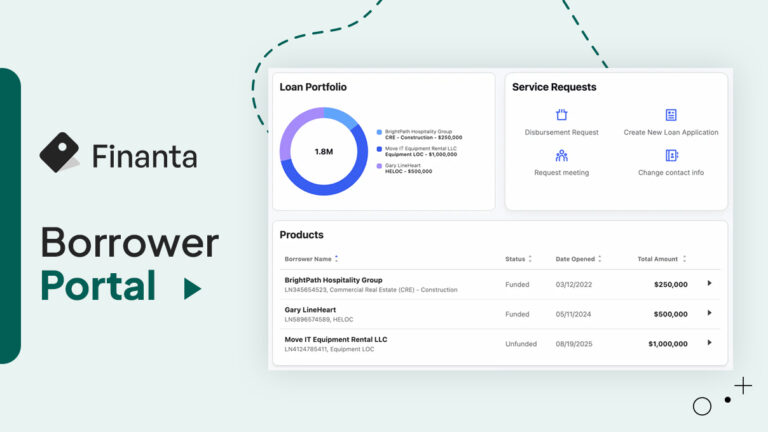
Finanta’s Dashboard and Loan Portfolio View give commercial borrowers a consolidated view across all active loans with live data integration, so balances, payment schedules, and collateral details reflect the actual system of record at the moment of login. For an institution managing a portfolio of any meaningful size, that real-time accuracy is the difference between a portal that reduces inbound volume and one that generates a new category of complaint.
2: A document hub that works in both directions
The most common document-related finding in commercial lending operations is that documents still travel by email long after a portal has been deployed. The reason is almost always the same: the portal allows document upload but does not allow download, or it allows both but without version control or organization. The FDIC’s 2024 survey found that document incompleteness is the single most common cause of extended cycle times in commercial lending, and a document hub that is genuinely two-directional is the most direct structural fix for that problem.
The criterion to apply to any vendor: can the borrower both retrieve statements, closing packages, and loan documents and upload financial statements, tax returns, and supporting documentation through a single, organized interface? Finanta’s Documents Hub handles both directions in an encrypted, version-controlled environment, so neither the borrower nor the lender’s team is ever uncertain about which version of a document is current or whether a submission was received.
3: Self-service for the routine requests that consume your servicing team
Payoff letter requests. ACH setup and changes. Contact information updates. Insurance certificate submissions. These are the requests that make up the majority of inbound servicing volume at commercial lending institutions, and at most lenders they are handled entirely by staff, by phone or email, taking between 15 and 45 minutes of servicing time per request. Individually, each one seems minor. Collectively, they represent a significant share of servicing overhead that adds cost without adding relationship value.
The right criterion here is not whether the portal accepts these requests but whether the borrower can track them after submission. A request that disappears into the portal without confirmation is worse than a phone call, because the borrower does not know whether it was received. Finanta’s Service Center allows borrowers to submit and track payoff requests, ACH changes, and contact updates directly through the portal, with visibility into status at each stage. This is also the foundation of effective commercial loan servicing at scale: routine requests handled without staff intervention, while relationship managers focus on the work that requires judgment.
4: Multi-user access that reflects how commercial borrowers actually operate
Consumer-facing portal vendors frequently struggle with commercial deployments for one specific reason: commercial borrowers are not individuals. A middle-market borrower managing a $20 million credit facility has a CFO, an outside accountant, legal counsel, and potentially a business partner who all need access to different parts of the loan record. A portal built for a single login per borrower forces all of that communication back to email the moment a second stakeholder needs to be involved.
The criterion is whether the portal supports role-based access controls at the borrower-team level, meaning each user can be granted a specific set of permissions that reflects their role in the transaction. Finanta’s Permissions Management module gives lending institutions granular control over multi-user access, so the accountant can view payment history without being able to submit payoff requests, and the business partner can access the loan portfolio view without seeing collateral valuation detail. For commercial lenders specifically, this is not an optional feature; it is a prerequisite for the portal to function in the way commercial borrowers actually work.
5: Proactive notifications that remove the need to log in and check
A borrower portal that requires the borrower to log in to find out whether anything has changed is not solving the transparency problem — it is moving it. The standard a good portal should meet is that the borrower receives proactive outreach when something requires their attention: a payment due date is approaching, a document request has been issued, the application has moved to a new stage, or a term change needs acknowledgment.
The J.D. Power 2025 U.S. Mortgage Origination Satisfaction Study found that overall satisfaction dropped 64 points when lenders first engaged borrowers only at the application stage, and that borrowers who received top-quality proactive guidance were 2.3 times more likely to return to the same lender for their next loan. Proactive communication is not a nice-to-have; it is the primary driver of borrower retention. Finanta’s notification engine covers payment due dates, document reminders, application stage changes, and lender announcements automatically, without requiring the borrower to initiate any action to stay informed.
6: Native integration with your LMS and core banking systems
The siloed portal is the most common failure mode in commercial lending technology, and it is also the hardest to identify during a vendor demonstration because the integration gap is not visible in a demo environment. The question to press on is technical: does the portal pull data from the same database as the loan management system, or does it maintain its own data store that syncs on a schedule? If the answer is the latter, every gap in that sync cycle is a gap in the borrower’s view of reality.
For institutions that need to connect to existing core banking systems, Finanta’s marketplace services integration covers all major core banking platforms and third-party systems, meaning the self-service borrower portal does not create a parallel data environment that needs to be managed separately.
7: Payment history detail that answers the questions borrowers actually ask
The second most common source of inbound servicing calls at commercial lenders is payment history enquiries. A borrower who believes a payment was applied incorrectly, or who needs to verify transaction dates for a refinancing or audit, cannot resolve that uncertainty from a portal that shows only a running balance and the date of the last payment. They call. Payment history visibility sounds like a minor feature until the servicing team is handling ten of these calls per week.
The criterion is whether the portal provides transaction-level detail: the date of each payment, the amount, the breakdown of how it was applied to principal, interest, and escrow, and the outstanding balance after each transaction. Finanta’s Payment History module gives borrowers that level of detail across all active loans, which reduces inbound call volume and simultaneously supports the audit trail requirements that commercial lending compliance demands. IBC Bank, managing an $8.8 billion portfolio across 15,000 loan records, saw its Audit Readiness Index improve by 34 percentage points after deploying Finanta, a result that reflects the audit-quality data the platform maintains at the transaction level.
Ready to see these borrower portal features in action at your institution? Book a demo and we will walk you through every capability on this list in the context of your loan portfolio.
8: Security and compliance that is architecture, not afterthought
The CFPB’s Winter 2025 Supervisory Highlights stated plainly that there is no advanced technology exception to Federal consumer financial laws. Any portal feature that collects applicant information, generates adverse action communications, or presents credit terms is subject to the full requirements of Regulation B, the Equal Credit Opportunity Act, and fair lending law. A portal whose security and compliance posture was retrofitted onto a consumer product is not a minor risk; it is an examination finding waiting to happen.
The criterion here is architectural: ask the vendor whether compliance requirements such as KYC, AML, OFAC/SDN screening, HVCRE, CRE, and HMDA obligations are built into the platform’s workflows or whether they are handled by a separate compliance overlay. Finanta is built with regulatory compliance, with Vigil, the embedded compliance module, continuously screening for risks, enforcing policies in real time, and auto-generating audit trails that reduce audit preparation time from weeks to minutes. Finanta customers have reported a 34-point improvement in Audit Readiness Index as a direct consequence of that architecture, representing not just operational efficiency but the examiner-ready documentation posture that protects the institution when scrutiny arrives.
How to Use This Framework When Evaluating Vendors?
These four questions take less than 20 minutes in any demonstration. The answers will tell you more about a portal’s fitness for commercial lending than any feature comparison document. Book a demo with the Finanta team to see how the platform performs against every criterion on this list.
Four questions that reveal whether a portal is genuinely built for commercial lending or is a consumer product with commercial branding applied:
Ask the vendor to show you a commercial borrower with three team members, each with different permission levels, accessing the same loan simultaneously. A portal that cannot demonstrate this live is one that will force your multi-stakeholder commercial borrowers back to email within the first month of deployment.
Ask them to walk through what happens when a borrower submits a payoff request through the portal. Show the full route: the submission, the notification to the servicing team, the status update the borrower sees, and the timeline from submission to fulfilment. If that workflow is opaque or requires a manual handoff at any stage, the servicing efficiency gains will not materialize.
Ask them directly whether the portal data store is the same as the LMS data store, or whether it syncs on a schedule. Press for the sync frequency. A 24-hour sync cycle means borrowers routinely see day-old data on balances and payment status.
Ask them to show you the audit trail a regulator would see if they requested documentation of a specific borrower interaction from 90 days ago. If the vendor has to consult their technical team or cannot show this immediately, the compliance architecture is not what it needs to be for a regulated lending institution.
These four questions take less than 20 minutes in any demonstration. To make your evaluation easier, we have distilled all 8 borrower portal features and these 4 demo questions into a single-page checklist you can take into any vendor conversation. Download the Borrower Portal Evaluation Checklist or speak with the Finanta team to see how the platform performs against every criterion on the list.
The difference between a borrower portal that genuinely improves satisfaction and one that creates a new category of operational complaint is almost always a feature-level decision made at the point of purchase. A lender who evaluates these 8 borrower portal features carefully before signing will earn compounding returns in servicing efficiency, audit readiness, and borrower retention that far exceed the initial investment.
Finanta’s Borrower Portal was built specifically for the complexity of commercial lending, with the integration depth, compliance architecture, and multi-stakeholder functionality that the commercial lending context demands. The lenders who build on the right infrastructure now will be positioned to meet borrower expectations as those expectations continue to rise, rather than reacting to the gap after it has already cost them relationships.
What does Adding a Branded Borrower Portal Cost within a Loan Management Solution?
The cost of adding a branded borrower portal can vary depending on what your lending business needs. Some of the main factors that influence pricing include:
Branding and customization: A portal designed around your brand, workflows, and borrower experience may cost more.
Integrations: Connecting with your existing loan management, LOS, CRM, or banking systems can affect the overall cost.
Features: Tools such as document sharing, e-signatures, messaging, payments, and loan tracking can impact pricing.
Security and compliance: Strong authentication, data protection, and compliance features may add to the investment.
Pricing model: Providers may charge a monthly subscription, per-user fee, or customized enterprise pricing.
The best approach is to request a quote based on your specific requirements and expected borrower volume.
How Should a CRE Borrower Portal Work?
A CRE (Commercial Real Estate) borrower portal should give borrowers one secure place to manage their loan relationship, submit documents, communicate with lenders, and track loan progress.
Key functionality should include:
Loan application tracking: Show application status, outstanding tasks, approvals, and next steps.
Document collection: Let borrowers securely upload financial statements, rent rolls, property documents, tax returns, leases, and other required files.
Property information: Organize property details, valuations, ownership information, and collateral documents.
Secure communication: Enable borrowers and lenders to exchange messages and receive important updates.
Automated notifications: Alert borrowers about missing documents, upcoming deadlines, requests, and status changes.
Loan information: Provide access to balances, payment details, interest rates, maturity dates, and loan terms.
Post-closing support: Allow borrowers to submit annual financials, compliance documents, covenant information, and servicing requests.
A CRE borrower portal should reduce back-and-forth communication, simplify document collection, improve transparency, and create a smoother borrower experience throughout the entire commercial real estate loan lifecycle.
Why borrowers don’t adopt borrower portals (and how to fix it)
Many lenders roll out a portal and find borrowers still email documents. The causes are usually predictable:
Why borrowers avoid the portal
How to fix it
Login is hard or forgotten
Use magic links or single sign-on; avoid forcing a new password for each request
They don’t know what to upload
Give a plain-language checklist with examples for each document
Email still works
Make the portal the only accepted channel after a short transition period
Uploading from a phone is clumsy
Support mobile photo uploads with automatic PDF conversion
The portal feels like extra work for them
Show progress and remove the need for status calls; pre-fill known data
Relationship managers don’t promote it
Train RMs to send every request through the portal and mention it on calls
See Finanta’s Borrower Portal in Action
Finanta is a purpose-built commercial lending platform whose Borrower Portal is designed specifically for the depth and complexity of commercial loans. From multi-user permissions management to real-time LMS integration and compliance-by-design security, every feature is built for the way commercial lending actually works.
What Are the Engaging Features for Loan Borrower Portals?
Engaging loan borrower portals should make the lending process simple, transparent, and convenient. Important features include personalized dashboards, secure document uploads, real-time loan status tracking, automated reminders, two-way messaging, digital forms, e-signatures, payment information, mobile-friendly access, and self-service task management. A branded experience can also help lenders create a consistent and professional borrower journey while reducing manual communication and follow-ups.
What borrower portal features should a commercial lending platform include?
The core borrower portal features for commercial lending are a unified loan dashboard with real-time data, a two-directional document hub, self-service request handling for payoff letters and ACH changes, role-based multi-user access for business borrowers, proactive notifications, seamless LMS integration, detailed payment history, and security architecture that is built in rather than bolted on. Each of these addresses a documented failure mode in commercial borrower experience. Finanta’s Borrower Portal covers all eight within a single integrated platform.
Can a borrower portal integrate directly with our loan management system?
Yes. Finanta’s Borrower Portal can provide a secure channel for borrowers to upload financial documents while connecting the borrower experience with your lending workflows. This helps centralize documents, reduce manual data entry, and give lending teams better visibility across the loan lifecycle.
What Platforms Make Borrower Financial Reporting Easier?
Platforms like Finanta Borrower Portal help lenders move borrower reporting from email to a secure, structured portal. Borrowers can submit financial statements, tax returns, rent rolls, and other documents without technical setup. This keeps reporting organized, reduces back-and-forth emails, and gives lenders better visibility into borrower information throughout the loan lifecycle.
Does Finanta Offer Borrower Portal Setup During Onboarding?
Yes. Finanta Borrower Portal can be configured during onboarding to match a lender’s branding, workflows, and reporting requirements. Lenders can set up borrower document collection, loan status updates, secure communication, financial reporting, and other portal features to create a seamless borrower experience without requiring borrowers to manage any technical setup.
How do borrower portal features improve commercial loan servicing efficiency?
The most direct efficiency gains come from self-service request handling and proactive notifications, which together reduce inbound servicing call volume for routine enquiries like payoff letters, payment status checks, and document submissions. Finanta customers have reported a 40% efficiency boost in commercial loan origination and a 72% reduction in cost overheads after deployment, with a 30% reduction in funding cycle time driven in part by eliminating manual document collection and status-check communications.
What security standards should a commercial lending borrower portal meet?
At minimum, a commercial lending borrower portal should provide data encryption in transit and at rest, multi-factor authentication, role-based access controls at both the institution and borrower-team levels, and a complete, timestamped audit trail of every user interaction. The CFPB’s Winter 2025 Supervisory Highlights confirmed there is no technology exception to Federal consumer financial laws, which means any portal collecting applicant information or presenting credit terms is subject to full Regulation B and fair lending scrutiny. Compliance architecture built into the platform from the start is not optional for regulated institutions.
Can a borrower portal integrate with an existing loan management system?
A well-built commercial lending borrower portal should integrate natively with the loan management system and core banking platforms rather than maintaining its own separate data store. Finanta’s marketplace services integration connects to all major core banking platforms and third-party systems, ensuring that the data borrowers see in the portal reflects the live system of record rather than a scheduled sync that can be hours or days out of date.
What is the difference between a borrower portal and a customer portal in commercial lending?
A customer portal is a general term that typically refers to any interface giving clients access to account information. A borrower portal in commercial lending is a more specific tool designed to support the entire loan lifecycle, from application and document collection through underwriting, closing, and ongoing servicing, with features specific to commercial complexity such as multi-user role-based access, loan-level payment history, and servicing request workflows. Consumer-facing customer portals adapted for commercial use typically fail at multi-stakeholder access, LMS integration depth, and the compliance architecture that regulated commercial lending requires.
How should a CRE borrower portal work?
It should handle the deal from application and due diligence through closing, then automate recurring requests for rent rolls, operating statements and financials, and flag covenant breaches.