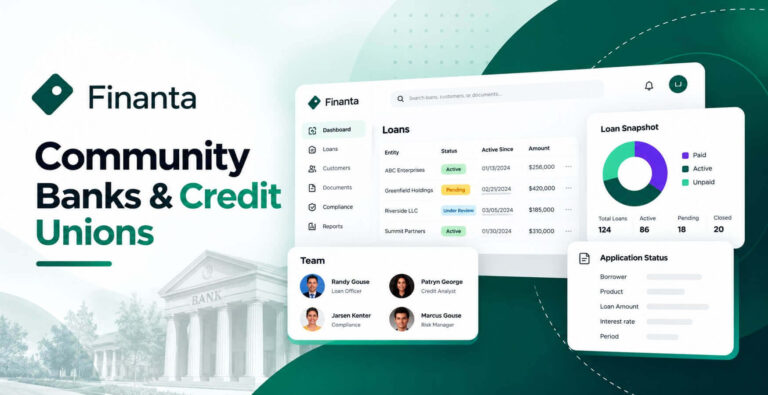
A borrower portal is a secure online platform that allows borrowers to interact with their lender throughout the loan lifecycle. Borrowers can use a portal to submit loan applications and documents, complete required tasks, track application or loan status, communicate with lenders, review loan information, and, depending on the lender, make payments or access account statements. For banks and commercial lenders, borrower portals provide a centralized digital experience that can reduce manual communication, simplify document collection, and improve transparency for borrowers.
The way people borrow money has changed, and borrower expectations have changed with it. Today’s applicants book travel, manage investments, file insurance claims, and pay bills entirely from a screen, often without speaking to a single person. When they approach a lender, they bring those same expectations with them. They want clarity, speed, and the ability to act on their own schedule rather than during business hours.
For many lenders, however, the borrowing process still relies on email chains, printed forms, faxed documents, and phone calls to check on status. The data backs this up: the FDIC’s 2024 Small Business Lending Survey found that only 24% of small banks and 42% of large banks accepted small business loan applications online. And even among those that do, fewer than half could handle the process digitally from end to end. This gap between what borrowers experience elsewhere and what they experience when applying for a loan has become one of the most significant friction points in lending. It frustrates applicants, slows down origination, and quietly erodes a lender’s competitive position.
A Borrower Portal closes that gap. By giving applicants a single, secure, self-service hub for everything related to their loan, it brings transparency, efficiency, and engagement to a process that has traditionally lacked all three. At Finanta, we built our Borrower Portal as a core component of an end-to-end commercial lending platform because we believe the borrower experience isn’t a feature you bolt on, it’s infrastructure you build from day one.
This article explains what a Borrower Portal is, the problems it solves, the features and benefits that matter most, and where the technology is heading.
What is a Borrower Portal?
A Borrower Portal is a secure, web-based interface that connects borrowers and lenders throughout the life of a loan. Think of it as a dedicated online space where users can track progress, communicate with their lending team, and sign agreements, all in one place and accessible from any device.
Rather than acting as a single-purpose tool, a digital borrower portal software supports the entire lending lifecycle. It is the front door at the moment of application, the workspace during underwriting and document collection, the signing room at closing, and the ongoing point of contact during servicing. Because it is self-service by design, the portal lets borrowers move at their own pace while giving lenders a structured, organized stream of information rather than a scattered pile of emails and attachments.
In practical terms, a loan borrower portal replaces the back-and-forth of traditional lending with a guided, transparent experience that benefits both sides of the transaction.
Common Challenges in Traditional Borrowing Processes
To appreciate what a Borrower Portal delivers, it helps to look at the pain points it is designed to eliminate. Traditional borrowing processes share a familiar set of frustrations.
The first is manual document collection. Borrowers are asked to gather tax returns, bank statements, identification, and financial records, then send them piecemeal through email or deliver them in person. Documents get lost, arrive in the wrong format, or are missed entirely.The second is lengthy email exchanges. A simple request for one missing form can spiral into a dozen messages across several days. These threads are hard to track, easy to misfile, and rarely give either party a clear picture of where things stand.
Third is limited visibility into loan status. Borrowers often have no idea whether their application is moving forward, stalled, or waiting on them. The only way to find out is to call and ask, which adds work for everyone.
Closely related is delayed communication. When updates depend on someone manually picking up the phone or drafting an email, important information can sit unaddressed for days. The J.D. Power 2025 U.S. Mortgage Origination Satisfaction Study quantifies the cost of this: overall satisfaction dropped by 64 points when lenders first engaged borrowers only at the application stage, compared to those who connected earlier in the journey.
All of this produces a poor customer experience. Borrowers feel uncertain and undervalued at one of the most consequential financial moments of their lives. And for the lender, every manual step adds to an already heavy administrative workload, pulling skilled staff away from higher-value work and into chasing paperwork.
Key Features of a Borrower Portal
A well-designed Borrower Portal directly addresses these challenges through a focused set of capabilities. The strongest platforms combine the following features into a single, cohesive experience.
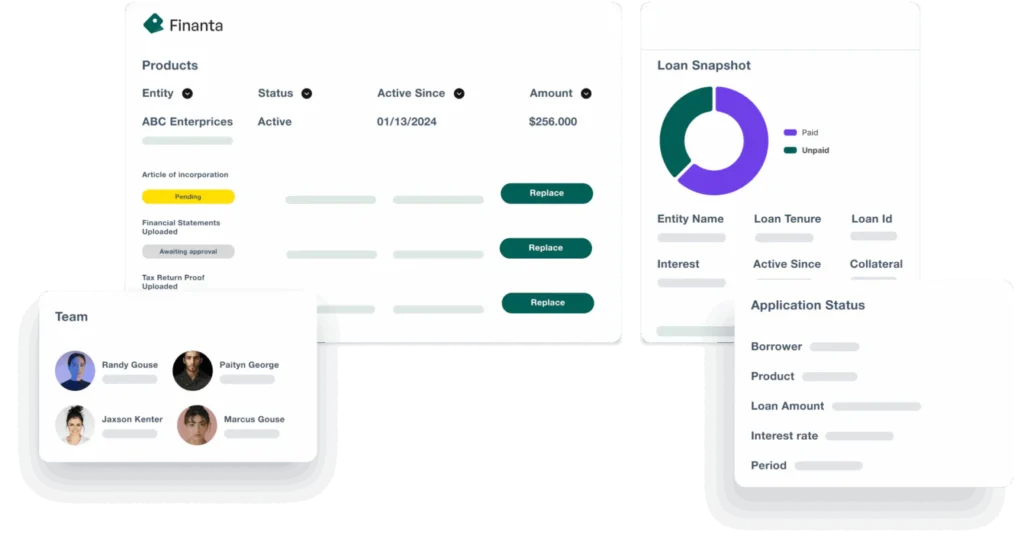
Secure document upload and sharing: Instead of email attachments, borrowers upload files directly into an encrypted environment, where they are automatically organized and matched requirements. Finanta’s Document hub handles everything from financial statements to identification, organized, version-controlled, and securely stored.
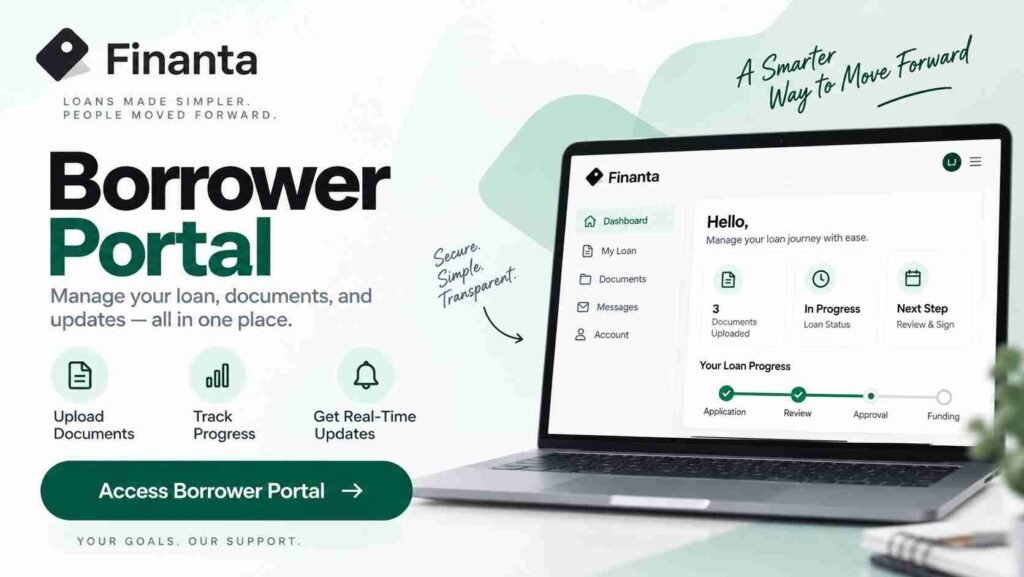
Real-time application status tracking: A clear progress view shows exactly where the application stands, what has been completed, and what comes next, eliminating the need for status-check of phone calls.
Task and checklist management: The portal presents borrowers with a personalized list of what they still need to provide, dynamically generated based on loan type, size, and borrower profile, removing guesswork and reducing back-and-forth.
Automated notifications and reminders: Timely alerts prompt borrowers to complete outstanding items, sign documents, or respond to requests, keeping applications from stalling.
Two-way messaging and communication: Secure, in-platform messaging keeps every conversation tied to the loan file, creating a single source of truth instead of scattered email and voicemail.
E-signature integration: Borrowers can review and sign disclosures and agreements electronically, accelerating steps that once required printing, mailing, or in-person visits. Finanta integrates with DocuSign, Adobe Sign, and other leading e-signature providers out of the box.
Mobile-friendly access: A responsive design lets borrowers apply, upload, and sign from a phone or tablet, meeting them wherever they are.
Multi-user access for business borrowers: Commercial and small-business applicants can grant access to partners, accountants, or guarantors, supporting the collaborative nature of business lending. Finanta’s role-based permissions management gives institutions granular control over who can see and do what.
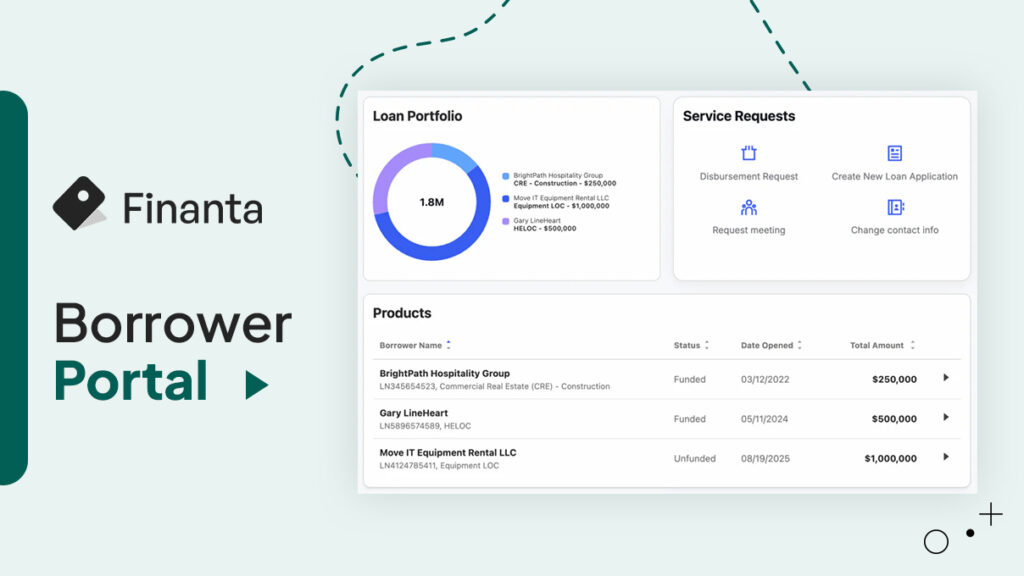
Dashboard with loan insights: A central dashboard summarizes loan details, outstanding tasks, recent activity, and key dates, giving borrowers a complete picture at a glance.
Borrower Portal Benefits
Benefits for Borrowers
For borrowers, the value of a self-service lending portal is immediate and tangible.The application process becomes faster and more convenient. Borrowers can start an application during a lunch break, finish it that evening, and upload a missing document the next morning without ever rearranging their day. They enjoy 24/7 access to loan information, checking status or retrieving a document whenever it suits them rather than waiting for office hours.
The experience also delivers greater transparency and control. Borrowers can see precisely where they are in the process and what is expected of them, which reduces anxiety during a high-stakes decision. Because documents and forms are handled digitally, there is significantly reduced paperwork, no printing, scanning, or physical mailing required.
Communication improves as well. With messaging and notifications built into the platform, borrowers experience improved communication with lenders and never have to wonder whether their question was received. Finally, a reputable portal provides enhanced security and trust, protecting sensitive financial information far better than email ever could and signaling that the lender takes data protection seriously.
Benefits for Lenders
The advantages for lenders are equally compelling and often translate directly to the bottom line. The most immediate gain is increased operational efficiency. When borrowers upload documents, and track their own progress, staff spend far less time on manual data entry and coordination. Finanta customers have reported up to a 40% efficiency boost in commercial loan origination and a 55% increase in loan volumes after deploying the Finanta Commercial Lending Platform, gains that stem directly from removing manual handoffs at every stage of the process.
This naturally leads to faster loan processing and decisioning, because complete, well-organized files reach underwriting sooner and with fewer gaps. Document incompleteness is the single most common cause of extended cycle times in commercial lending, according to the FDIC’s 2024 Small Business Lending Survey. A portal that validates completeness at intake removes that bottleneck before it starts.
A Borrower Portal also delivers reduced manual follow-ups. Automated reminders handle the routine nudging that once consumed hours of staff time, freeing teams to focus on judgment-intensive work. The result is improved borrower satisfaction, which strengthens relationships and drives referrals and repeat business.
Because the portal guides borrowers through each step and prompts them when items are outstanding, lenders see higher application completion rates and fewer applicants abandoning the process midway. The structured, time-stamped record of every document and interaction supports better compliance and audit readiness, making it easier to demonstrate that required steps were followed. Taken together, these efficiencies contribute to lower servicing costs, Finanta customers have seen overhead reductions of up to 72% after moving from legacy systems to the Finanta platform.
How a Borrower Portal Supports the Loan Lifecycle?
One of the defining strengths of a Borrower Portal is that it adds value at every stage of the loan, not just at the point of application.It begins with application submission, where borrowers complete intelligent digital forms tailored to their loan type. From there, the portal facilitates document collection and verification, presenting a clear checklist, accepting secure uploads, and organizing files so nothing is overlooked.
During underwriting collaboration, the portal becomes a shared workspace. When underwriters need additional information, they can request it directly, and borrowers can respond without delay, keeping the file moving. At approval and closing, e-signature and digital disclosure capabilities allow agreements to be reviewed and executed quickly and remotely.
The relationship does not end at funding. The portal continues to support ongoing servicing and communication, giving borrowers a familiar place to access documents, view loan details, and stay in touch with their lender well after closing. Finanta’s end-to-end loan lifecycle management covers everything from origination through collateral management, covenant tracking, and portfolio reporting, the Borrower Portal is the borrower-facing layer of a system that runs the full depth of the lending operation.
This continuity turns a one-time transaction into a lasting digital relationship.
Security and Compliance Considerations
Because lending involves highly sensitive personal and financial data, security and compliance are not optional features but foundational requirements. A trustworthy Borrower Portal is built with protection in mind at every layer. Role-based access controls ensure that each user, whether a borrower, co-applicant, or staff member, sees only the information appropriate to their role. Data encryption, both in transit and at rest, safeguards documents and personal details against interception or unauthorized access.
Secure authentication methods, including multi-factor authentication, verify that only authorized users can enter the portal. Comprehensive audit trails record who accessed what and when, creating an accountable, reviewable history of every action. Regulatory frameworks including the Gramm-Leach-Bliley Act’s Safeguards Rule, Regulation B, and CFPB guidance all apply to borrower-facing portals, a point the CFPB’s Winter 2025 Supervisory Highlights made explicit: there is no advanced technology exception to Federal consumer financial laws. Together with features that provide regulatory compliance support, these safeguards help lenders meet their obligations while giving borrowers confidence that their information is handled responsibly.
Finanta is built with regulatory compliance by design, KYC, AML, OFAC/SDN screening, HVCRE, CRE, and HMDA requirements are embedded into the platform’s workflows, not layered on as an afterthought.
How Do Banks and Credit Unions Use Borrower Portals?
Banks and credit unions use borrower portals to give customers a secure, convenient way to manage loan applications, submit documents, communicate with lending teams, and track loan progress online. For commercial lenders, a borrower portal can bring these activities into one digital workspace, reducing manual follow-ups and making the lending process easier for both borrowers and lenders.
Instead of sending documents back and forth through email or calling a loan officer for every status update, borrowers can log in to a centralized portal to see what is needed, complete outstanding tasks, and check the status of their loan.
How Do Banks Use Borrower Portals?
Banks use borrower portals across different stages of the lending lifecycle, from application and underwriting through closing and ongoing loan management. Common uses include:
1. Collecting and Managing Loan Documents
Commercial loan applications often require financial statements, tax returns, business information, ownership documents, collateral details, and other supporting documentation. A borrower portal gives customers a secure place to upload these documents and allows lending teams to organize and review them. Borrowers can also see which documents have been submitted and which items are still outstanding. This can reduce email exchanges and make document collection more organized for both the borrower and the lender.
2. Giving Borrowers Real-Time Loan Status Updates
One of the biggest advantages of a borrower portal is visibility. Instead of asking a lender, “What is the status of my application?” borrowers can log in and see where their loan stands. Depending on the lender’s workflow, the portal may show whether an application is being reviewed, additional information is required, documents are pending, or the loan has moved to the next stage. For banks and credit unions, this added transparency can also reduce routine status-related calls and emails.
3. Improving Communication Between Borrowers and Lenders
A borrower portal can provide a centralized location for messages, document requests, notifications, and other lending-related communication. This is especially useful for commercial lending, where a single loan may involve multiple people on the borrower’s side, such as business owners, CFOs, controllers, or authorized representatives. Keeping communication and lending tasks in one place can make it easier for everyone involved to stay aligned.
4. Simplifying the Commercial Loan Application Process
Commercial lending can involve multiple steps and significant documentation. Borrower portals help financial institutions move more of these interactions online. A borrower may be able to complete application tasks, upload financial information, respond to lender requests, review documents, and monitor progress without relying entirely on phone calls, email, or branch visits. For community banks and credit unions, this can help create a more modern digital lending experience while maintaining the personal service they are known for.
5. Supporting Digital Loan Closing
Some borrower portals can support digital closing workflows by allowing borrowers to review documents, complete required tasks, and use integrated electronic signature solutions. This can make the closing process more convenient and reduce the amount of physical paperwork involved in completing a loan. For lenders serving borrowers across different locations in the U.S., digital workflows can also make it easier to manage closing activities without requiring every interaction to happen at a branch.
6. Managing Loans After Closing
A borrower portal does not have to stop being useful once a loan is approved and closed.
Banks and credit unions can use portals for ongoing loan management activities, including:
Collecting updated financial statements
Requesting annual review documents
Managing compliance-related documentation
Sharing loan documents
Communicating with borrowers
Tracking outstanding borrower requests
Providing access to loan information
This allows the portal to become part of the broader borrower relationship rather than simply being an application tool.
7. Creating a Better Borrower Experience
Today’s borrowers increasingly expect the same convenience from financial services that they experience with other digital products. They want to know what is happening, what information is needed, and what they need to do next. A borrower portal gives banks and credit unions a way to provide that visibility while keeping sensitive lending information within a secure digital environment. For relationship-focused institutions, the goal is not necessarily to replace the loan officer. Instead, the portal can handle routine digital interactions while lending teams continue to focus on advice, relationship management, and more complex lending decisions.
How Do Credit Unions Use Borrower Portals?
Credit unions can use borrower portals to make lending more convenient for members while maintaining the personalized service that differentiates the credit union model. For example, a credit union may use a borrower portal to allow members to submit documents, receive application updates, communicate with lending staff, and complete required lending tasks online. This can be particularly valuable for credit unions that want to improve their digital member experience without losing the personal relationship between members and lending teams.
What Are the Benefits of Borrower Portals for Banks and Credit Unions?
The benefits can extend beyond convenience for borrowers. A well-designed borrower portal can help financial institutions improve several parts of their lending workflow.
Key benefits include:
Faster document collection: Borrowers have a clear place to submit required information.
Less manual follow-up: Automated requests and status updates can reduce repetitive emails and phone calls.
Greater transparency: Borrowers can see application progress and outstanding tasks.
Better borrower experience: Customers get a convenient digital way to interact with their lender.
Centralized communication: Messages, documents, and requests can be managed in one place.
Improved operational efficiency: Lending teams can spend less time managing routine borrower interactions.
Stronger ongoing relationships: Portals can continue supporting borrowers after loan closing.
How Does a Borrower Portal Work With a Loan Origination System?
A borrower portal and a loan origination system (LOS) serve different purposes, but they can work together as part of a connected lending technology stack. The borrower portal is the digital interface that borrowers use, while the loan origination system manages the lender’s internal loan workflow. For example, a borrower may upload a financial statement through the portal. That information can then move into the lender’s lending workflow, where the appropriate team members can review it and take the next step. When these systems are connected, banks and credit unions can create a more seamless experience between the borrower-facing and lender-facing sides of commercial lending.
Are Borrower Portals Only Used for New Loan Applications?
No. Banks and credit unions can use borrower portals throughout the entire lending relationship. While portals are commonly associated with loan applications and document collection, they can also support activities after closing, such as annual reviews, financial statement collection, covenant monitoring, document requests, borrower communication, and ongoing loan management. This makes a borrower portal more than an application tool. It can become a central digital channel for managing the borrower relationship throughout the loan lifecycle.
What Should Banks and Credit Unions Look for in a Borrower Portal?
When evaluating borrower portal software, financial institutions should look beyond basic document upload capabilities. A portal should support the needs of both borrowers and lending teams.
Important capabilities can include:
Secure document upload and sharing
Real-time application and loan status
Automated notifications and task reminders
Two-way borrower-lender communication
Support for multiple authorized users
Digital forms and workflows
Electronic signature integrations
Mobile-friendly access
Integration with loan origination systems
Support for post-closing loan management
Appropriate security and access controls
For commercial lenders, the ability to connect the borrower portal with existing lending systems is particularly important. The goal is to create a connected experience rather than another standalone system that requires additional manual work.
Borrower Portal Use Cases
While the concept applies broadly, Borrower Portals deliver distinct value across many lending segments.
In commercial lending, where transactions are complex and document-heavy, a portal organizes voluminous financials and supports the multiple stakeholders typically involved. For small business lending, it streamlines an application process that owners often have little time to manage, letting them provide information in the margins of a busy day.
In mortgage lending, the portal tames one of the most document-intensive processes in finance, guiding borrowers through disclosures, income verification, and closing. For consumer lending, it delivers the fast, mobile-first experience applicants expect for personal loans and lines of credit.
Equipment financing benefits from streamlined collection of quotes, invoices, and business documentation, while SBA lending, known for its extensive paperwork and program-specific requirements, is made far more manageable through structured checklists and secure document handling. Across all of these, a commercial lending software platform anchored by a strong borrower portal turns complexity into a guided, repeatable workflow.
Finanta’s platform supports dozens of collateral types out of the box, from Commercial Real Estate and Construction Loans to Equipment Finance, Agricultural Lending, and Specialized Finance, meaning the same portal infrastructure that handles a straightforward term loan also scales to the most complex multi-collateral structures. Unique, lender specific collateral types are supported as well.
Future Trends in Borrower Portals
Borrower Portals continue to evolve, and several trends point toward an even more capable and personalized future.
AI-driven borrower assistance is emerging in the form of intelligent virtual assistants that answer questions, explain requirements, and guide borrowers through each step in plain language. This is valuable, but context matters: the J.D. Power 2025 study found that 71% of borrowers say it is very important to be informed when their lender is using AI. Transparency about AI use isn’t just good practice; it is a borrower expectation.
Open banking integrations are streamlining verification by allowing borrowers to securely connect bank and financial accounts, replacing manual statement uploads with instant, accurate data. Finanta integrates natively with MX, Plaid, and Boss Insights to accelerate financial data collection and analysis, one of the most time-consuming parts of the underwriting process.
Intelligent document processing uses automation to read, classify, and extract information from uploaded documents, dramatically cutting manual review time. The shift toward mobile-first experiences continues to accelerate as more borrowers expect to complete the entire journey from their phones. And predictive engagement capabilities are beginning to anticipate borrower needs, flagging likely roadblocks or reaching out proactively before an application stalls.
The institutions that deploy these capabilities most effectively will be those that use them to amplify relationship capacity, freeing their lenders from administrative work to do what no algorithm can replicate: understand the business, structure the right deal, and build the trust that drives repeat lending.
Conclusion
Delivering a seamless digital experience is no longer a differentiator in lending; it is an expectation. Borrowers compare their loan experience not to other lenders alone but to every polished digital service they use daily, and they reward institutions that meet that standard. The Federal Reserve Banks’ 2024 Small Business Credit Survey found that net satisfaction with commercial lenders is declining, which means the window for institutions to differentiate on experience is open, and closing.
A Borrower Portal answers this expectation directly. By replacing manual document collection, fragmented communication, and opaque status updates with a secure, self-service, transparent platform, it improves efficiency for lenders and satisfaction for borrowers at the same time. It accelerates processing, strengthens compliance, lowers costs, and supports the borrower relationship from the first application through ongoing servicing.
For lenders weighing how to stay competitive, the path forward is clear. The question isn’t whether to invest in a better borrower experience it is whether to build that experience on infrastructure that can actually support it end to end.
See Finanta’s Borrower Portal in Action
Finanta is a SaaS commercial lending platform built for banks, credit unions, and non-bank lenders ready to grow. Our Borrower Portal solution is one piece of a unified, life-of-loan system that covers origination, underwriting, decisioning, closing, servicing, collateral management, and portfolio reporting, all under your brand. It is available as part of our commercial lending suite or as a modular add-on that can be integrated into an FI’s existing legacy systems.
Book a demo → to see how Finanta’s Borrower Portal reduces cycle times, cuts document friction, and gives your borrowers the experience they expect.Or explore the full platform to see how the portal fits into a complete commercial lending stack.
A Borrower Portal is a secure online platform where borrowers can apply for loans, upload documents, track their application status, communicate with their lender, and sign agreements, all in one place across the entire loan lifecycle. Finanta’s Borrower Portal is purpose-built for commercial lending, with multi-user access, role-based permissions, and deep integration into the origination and servicing workflow.
What are the Best Borrower Portal for Loan and Lease Management in the USA?
Top borrower portals for loan and lease management in the USA include Finanta, nCino, FIS, Nortridge, and Abrigo. Finanta offers a borrower portal for loan and lease management, focusing on self-service account access and payment tools, LoanPro, known for API-first architecture and self-serve borrower tools, Nortridge Loan System with its borrower portal for self-service hardship enrollment and account management, and LendingWise, popular for real estate and commercial finance borrower portals.
How does a Borrower Portal work?
Borrowers log in to a secure interface to complete a digital application, follow a personalized checklist of required items, upload documents directly, receive automated reminders, message their lending team, and monitor real-time progress until the loan closes and beyond.
Can borrowers track their loan application status online?
Absolutely. Real-time status tracking is a core feature, allowing borrowers to see exactly where their application stands and what steps remain without needing to call or email for updates.
What documents can be uploaded through a Borrower Portal?
Borrowers can typically upload identification, tax returns, bank statements, financial records, business documents, and any other materials the lender requires, all through secure, encrypted uploads.
How does a Borrower Portal benefit lenders?
It increases operational efficiency, speeds up processing and decisioning, reduces manual follow-ups, improves borrower satisfaction and completion rates, strengthens compliance and audit readiness, and lowers servicing costs. Finanta customers report up to a 40% efficiency boost in origination and a 72% reduction in cost overheads.
Can Borrower Portals integrate with existing lending systems?
Most modern borrower portals are designed to integrate with loan origination systems, core banking platforms, and other lending software. Finanta integrates with major core banking platforms including Fiserv, FIS Core, Jack Henry, Temenos, Q2, and Alkami, as well as credit agencies, e-signature providers, and open banking data sources like Plaid and MX.
Do Borrower Portals support e-signatures?
es. E-signature integration is a standard feature, enabling borrowers to review and sign disclosures and agreements electronically to accelerate approval and closing.
How do Borrower Portals improve the borrower experience?
They provide a faster, more convenient process with 24/7 access, greater transparency and control, reduced paperwork, better communication, and stronger security. Research from J.D. Power’s 2025 Mortgage Origination Study shows that borrowers who receive proactive guidance from their lender throughout the process are 2.3x more likely to return for their next loan, and the portal is the infrastructure that makes that level of engagement scalable.
What is the difference between a borrower portal and a loan origination system?
A borrower portal is a digital interface that allows borrowers to submit applications, upload documents, track loan status, communicate with lenders, and manage loan-related information. A loan origination system (LOS) is the backend platform lenders use to manage the end-to-end lending process, including application intake, credit analysis, underwriting, decisioning, documentation, and approval. In simple terms, the borrower portal focuses on the borrower experience, while the LOS manages the lender’s loan workflow. The two systems can work together to create a more streamlined commercial lending process.
How do banks and credit unions use borrower portals?
Banks and credit unions use borrower portals to streamline communication and make commercial lending more convenient for borrowers. Through a borrower portal, customers can submit loan applications, upload and securely share documents, check application status, respond to requests, review loan information, and communicate with lending teams. For lenders, borrower portals can reduce manual follow-ups, improve document collection, increase transparency, and create a more consistent digital lending experience.
Which digital lending platforms give borrowers real-time visibility into document status and loan timelines?
Digital lending platforms such as Finanta can give borrowers greater visibility into the lending process through a centralized borrower portal. Borrowers can use the portal to submit and access documents, respond to lender requests, track application progress, and stay informed about important loan milestones. For banks and credit unions, this type of borrower portal can improve transparency, reduce manual follow-ups, and create a more streamlined digital lending experience.
How does a borrower portal help with SBA loans?
A borrower portal can give small-business borrowers a centralized digital experience for completing loan-related tasks. Depending on the lender and loan program, borrowers may be able to submit applications, upload required documents, monitor application status, review loan information, and communicate with their lender. The SBA’s own online loan systems demonstrate how digital portals can support activities such as application management, loan-status tracking, statements, and payments.
Why are borrower portals important for community banks and credit unions?
Borrower portals help community banks and credit unions offer a convenient digital experience while maintaining relationship-based lending. They can simplify routine interactions while allowing lending teams to focus on personalized borrower support and more complex lending decisions.
What is an SBA loan, and how does it work?
An SBA loan is a business loan offered by an SBA-approved lender and partially guaranteed by the U.S. Small Business Administration. This guarantee can help eligible small businesses access financing for needs such as working capital, equipment, commercial real estate, expansion, or refinancing. Borrowers apply through participating lenders, while the SBA provides the guarantee under the applicable loan program.
What are the most engaging features for loan borrower portals?
The most engaging loan borrower portal features make it easier for borrowers to complete tasks, communicate with lenders, and stay informed throughout the lending process. Key features include real-time loan status tracking, secure document upload, automated notifications, two-way messaging, digital forms, personalized dashboards, mobile accessibility, electronic signatures, and centralized access to loan documents. For banks and credit unions, these capabilities can reduce manual follow-ups while creating a more transparent and convenient borrower experience.